Walmart beat Q2 FY27 earnings and raised its full-year outlook, yet WMT fell more than 9%. The reason was simple: investors cared more about weaker U.S. sales momentum and soft Q3 guidance than the quarter Walmart had already finished.
Walmart beat earnings. Revenue beat expectations. Full-year guidance went up.
Then the stock fell more than 9%.
The market was not punishing Walmart for Q2. It was repricing what came next: U.S. comparable sales missed expectations, and Q3 EPS guidance came in below consensus.
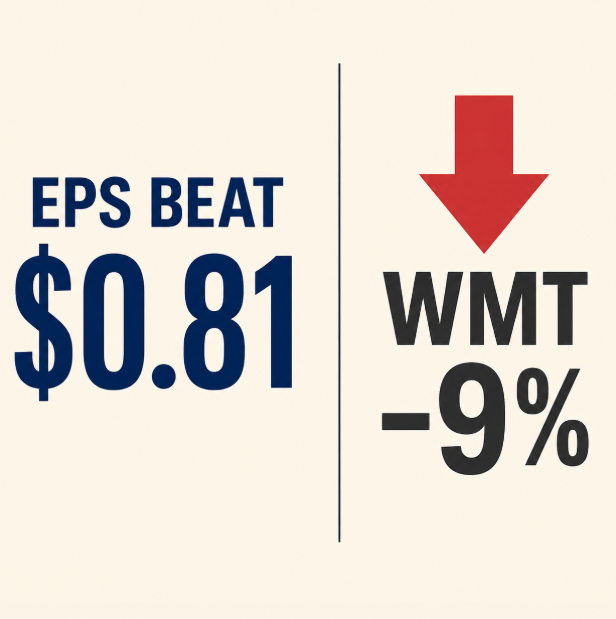
Table of Contents
Walmart's Q2 report looked good at first glance.
Adjusted EPS came in at $0.81, above the roughly $0.74 Wall Street estimate. Revenue reached about $187.9 billion, also ahead of expectations. Walmart even raised its full-year sales and earnings outlook.
And WMT still dropped more than 9%.
That looks irrational.
It wasn't.
Investors cared less about the quarter Walmart had already finished than about the numbers pointing to the next one.
The Beat Was Real. So Was the Miss.
The cleanest way to understand the selloff is to separate Walmart's headline results from the numbers that changed forward expectations.
| Metric | Result | Expectation | Signal |
| Adjusted EPS | $0.81 | ~$0.74 | Beat |
| Revenue | $187.9B | ~$186.6B | Beat |
| U.S. comp sales | +2.6% | ~+3.8% | Miss |
| Q3 adjusted EPS guidance | $0.62–$0.64 | ~$0.68 | Miss |
Q2 was better than expected. Q3 looked worse than expected. And stocks trade on the second sentence.
Walmart U.S. comparable sales grew just 2.6%, versus roughly 3.8% expected. Traffic growth also slowed, while average ticket growth weakened.
For a company that had built a reputation for consistently taking share and outperforming expectations, that was enough to raise a harder question: Is Walmart's U.S. growth momentum starting to cool?
But the 2.6% Comp Number Looks Worse Than It Really Was
This is where the easy bearish story breaks down.
Walmart said lower pharmacy prices tied to Medicare's Maximum Fair Price program reduced U.S. comparable-sales growth by roughly 125 basis points.
Excluding Health & Wellness, U.S. comp growth was 3.4%.
Still below expectations.
But not nearly as ugly as 2.6% makes it look.
So the takeaway is not:
“The U.S. consumer is collapsing.”
The better reading is:
Walmart's growth slowed enough to disappoint a market that was priced for cleaner execution.
That is a much narrower — and more defensible — conclusion.
The Bigger Problem Was Q3
The number investors could not ignore was Walmart's next-quarter guidance.
- The company guided Q3 adjusted EPS to: $0.62–$0.64
- Wall Street had been around: $0.68
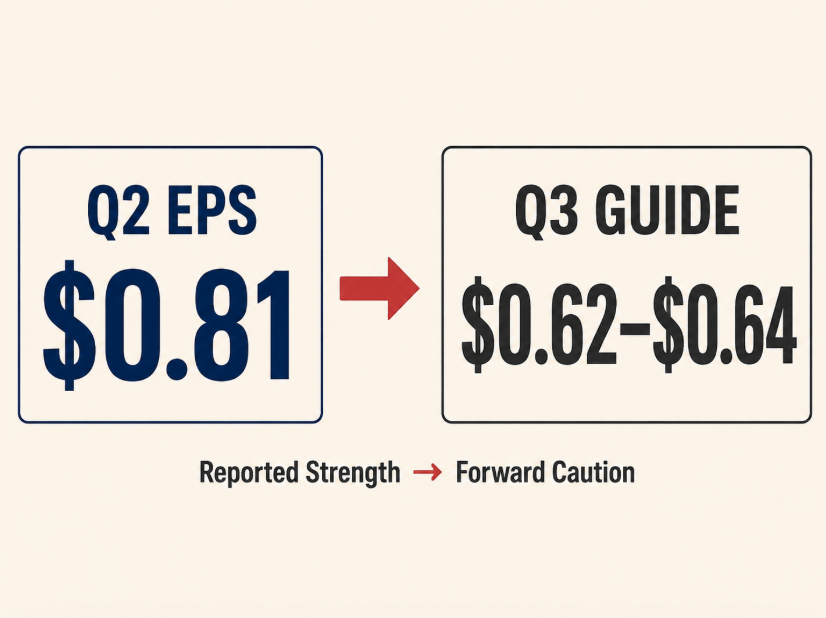
Q2 EPS tells investors what Walmart already earned.
Q3 guidance tells them what management thinks comes next.
The market did not suddenly decide Walmart's Q2 numbers were bad.
It decided the earnings path after Q2 looked weaker than expected.
That is why an earnings beat and a 9% stock drop can happen on the same day.
Raised Full-Year Guidance Did Not Save the Stock
Walmart also raised its fiscal 2027 outlook.
Net sales growth guidance increased to 4%–5%, while adjusted EPS guidance rose to $2.80–$2.87.
Normally, that would support the stock.
This time, it wasn't enough.
Why?
Because investors were being asked to accept three things at once:
Strong Q2 earnings.
Higher full-year targets.
A softer Q3 earnings bridge.
When a stock has already run hard, “good” is not always good enough.
WMT had more than doubled from early 2024 levels before this report. Expectations were high.
The quarter did not need to be disastrous to trigger a selloff.
It only needed to be less perfect than the market expected.
Walmart's Store Sales Are No Longer the Whole Story
There was another reason not to read the selloff too simply.
Walmart's traditional retail growth slowed, but several higher-growth businesses kept accelerating.
- Walmart U.S. comp sales: +2.6%
- Walmart U.S. e-commerce: +24%
- Global e-commerce: +23%
- Global advertising: +38%
- Global membership fee revenue: +17%

Walmart is no longer just a low-margin retailer moving more products through stores.
Advertising, marketplace services, memberships and fulfillment are becoming more important to its economics.
So slower store sales do not automatically mean the entire earnings model is weakening at the same speed.
This is the part of the report that makes the 9% drop more interesting than a simple “consumer weakness” story.
Retail momentum softened. The broader monetization engine did not.
So Was the 9% Drop Justified?
The report gave investors a legitimate reason to cut near-term expectations.
- Comparable sales missed.
- Q3 guidance was soft.
- Traffic and ticket growth slowed.
- Those are real negatives.
But the evidence does not support a “Walmart is breaking” thesis.
- Revenue beat.
- EPS beat.
- Full-year guidance rose.
- E-commerce, advertising and memberships remained strong.
- And the headline 2.6% comp number was partly distorted by pharmacy pricing.
The sharper conclusion is this: Walmart's business did not collapse. Its margin for error did. That distinction matters.
When expectations are high, a stock can fall hard even if the underlying company is still performing well.
What Investors Should Watch Next
The next report should answer whether this was a one-quarter reset or the start of a real slowdown.
Three things matter most:
1. U.S. comp sales excluding Health & Wellness
If underlying comp growth remains weak after the pharmacy distortion fades, the slowdown becomes harder to dismiss.
2. Q3 EPS versus the $0.62–$0.64 guide
A result above that range would weaken the bearish interpretation. A miss would strengthen it.
3. Advertising, membership and e-commerce growth
If those businesses keep growing much faster than store sales, Walmart's profit mix may continue improving even if traditional retail growth moderates.
The main point is simple.
Walmart's Q2 was not bad.
The market just cared more about the next quarter than the last one.
That is why Walmart could beat earnings, raise guidance — and still lose 9% in a day.
FAQ
Why did Walmart stock fall after earnings?
Walmart stock fell because investors focused on weaker U.S. comparable-sales growth and Q3 EPS guidance below Wall Street expectations, despite a Q2 earnings beat.
Did Walmart miss Q2 earnings?
No. Walmart reported adjusted EPS of $0.81, above the roughly $0.74 consensus, while revenue also beat expectations.
Is Walmart's 2.6% comparable-sales growth as weak as it looks?
Not entirely. Walmart said pharmacy pricing reduced U.S. comparable-sales growth by about 125 basis points. Excluding Health & Wellness, comp growth was 3.4%.
What matters most in Walmart's next earnings report?
Watch U.S. comparable sales excluding pharmacy effects, Q3 EPS versus guidance, and whether advertising, membership and e-commerce growth remain strong.
Why Alphabet Issued Its First Australian Dollar Bond: Inside Google's AI Financing Playbook
Why Alphabet Issued Its First Australian Dollar Bond: Inside Google's AI Financing Playbook
더보기Alphabet issued an inaugural A$5.5B Kangaroo bond to diversify funding for its $200B AI infrastructure buildout. Here is what the deal proves for tech balance sheets. Alphabet's inaugural A$5.5 billion ($3.9 billion) Australian dollar bond issuanc
global.kkomccom.com
Why Moderna Surged 177%: What the Phase 3 Cancer Vaccine Data Actually Proves
Why Moderna Surged 177%: What the Phase 3 Cancer Vaccine Data Actually Proves
더보기Moderna surged 177% following positive Phase 3 cancer vaccine data with Merck. Here is what the topline trial results prove, what remains unverified, and why Wall Street repriced the mRNA oncology platform.Moderna’s 177% single-day surge was not
global.kkomccom.com