Nvidia expects about 70% revenue growth in fiscal 2028, yet it still describes supply as constrained. Here is how memory availability and rising memory costs can limit shipments and pressure margins at the same time.
Nvidia expects revenue to grow roughly 70% in fiscal 2028, the fiscal year ending in January 2028. Yet the company still describes the outlook as supply-constrained, with memory components among the pressure points.
That is the tension worth watching. Nvidia does not appear short of AI demand. The harder question is how much of that demand it can turn into finished systems—and how much it must pay memory suppliers to do it.
Nvidia just reported $96.2 billion of quarterly revenue. Its Data Center business alone produced $89.0 billion, and the company expects roughly $108 billion in revenue next quarter. Then came the number that made those already enormous figures look almost like a starting point: management expects revenue to grow about 70% in fiscal 2028.
The strange part is what came next. The outlook is still “supply-constrained.”
That sounds contradictory at first. A company forecasting 70% growth usually makes investors ask whether demand can possibly stay that strong. Nvidia is pointing toward a different question: what if customers want more AI hardware than the supply chain can actually produce?
That is where memory becomes much more interesting than a normal component-cost story.
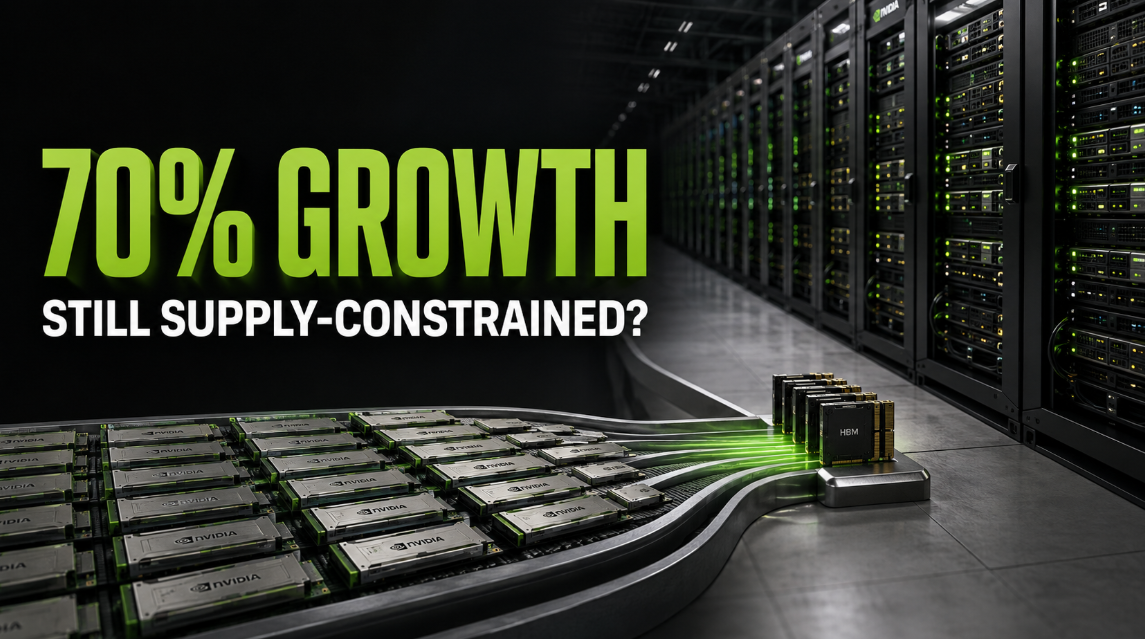
Table of Contents
70% Growth Does Not Mean Calendar 2028
The date needs to be clear before going any further. Nvidia’s fiscal 2028 ends in January 2028, so the forecast largely describes business generated during calendar 2027. It is also an outlook, not 70% of revenue already secured or guaranteed.
The scale is still remarkable. Nvidia reported second-quarter fiscal 2027 revenue of $96.2 billion, up 106% from a year earlier, while Data Center revenue reached $89.0 billion. Nvidia’s official third-quarter outlook is approximately $108 billion, plus or minus 2%.
| Metric | Current figure | What it tells us |
| Q2 FY2027 revenue | $96.2B | Nvidia is growing from an enormous base |
| Q2 Data Center revenue | $89.0B | AI infrastructure dominates the business |
| Q3 FY2027 outlook | $108B ±2% | Near-term growth remains extremely strong |
| FY2028 revenue growth outlook | ~70% | Growth remains exceptional despite supply limits |
| Q2 gross margin | 75.0% | Current profitability remains very high |
| Q3 gross-margin outlook | ~74% | Component inflation starts to become visible |
| Expected Q4 margin trough | 71%–72% | Memory costs become much harder to ignore |
| Expected FY2028 margin range | 72%–73% | Pricing may recover part of the pressure |
The 70% figure is not the whole story. The more useful question is what prevents that number from being even higher?
Strong Demand Can Exist at the Same Time as Slower Shipments
A demand problem and a supply problem can produce the same visible result: Nvidia ships fewer systems than customers would like to buy. The economics behind them are completely different.
If demand weakens, the company has enough products but not enough buyers. If supply is constrained, buyers are still there, but Nvidia cannot assemble and deliver every system they want. Nvidia’s outlook matters because the company is describing a business where strong AI demand can coexist with limitations on how much hardware the supply chain can physically deliver.
That distinction matters because an Nvidia accelerator is not a finished AI system by itself. It has to be paired with HBM and other memory, advanced packaging, networking, CPUs, power hardware and many other components before a customer can deploy usable compute.
One missing part can restrict the output of the entire chain. That is the bottleneck.
Memory Is Actually Two Bottlenecks
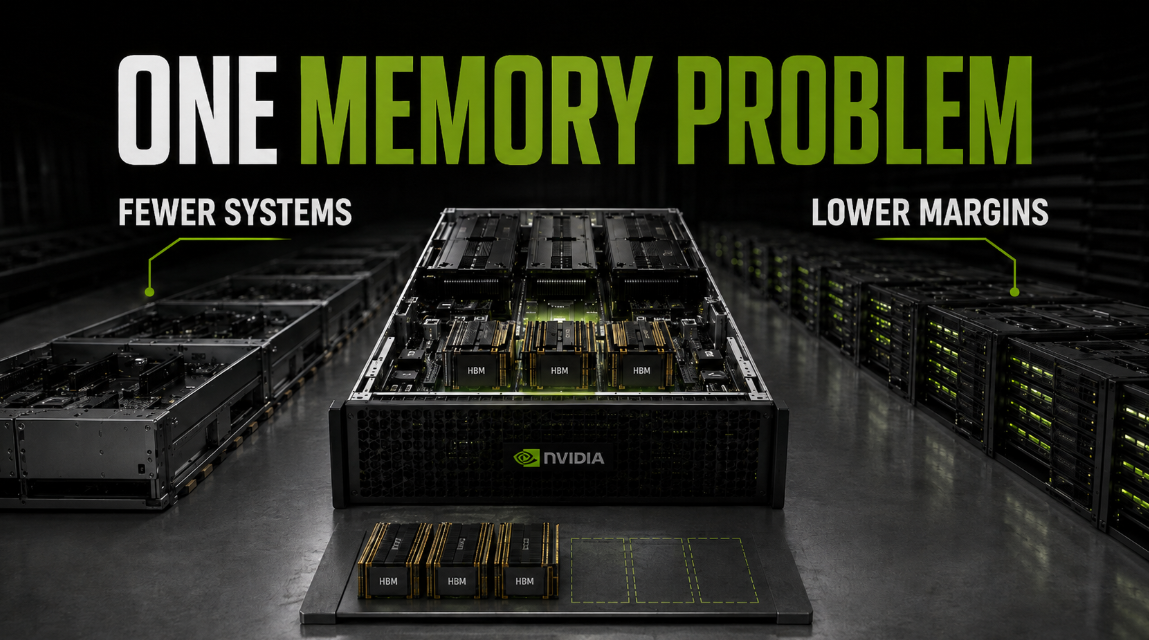
Calling this simply a “memory shortage” hides the most important part of the story. Memory can hurt Nvidia through quantity. It can also hurt Nvidia through price. Those are different mechanisms.
When Memory Is Unavailable, Nvidia Can Ship Fewer Systems
Suppose Nvidia has enough demand and GPU capacity for 100 additional AI systems, but the supply chain can provide the required memory for only 80. Customer demand for 100 does not create 100 shipments. The usable output is 80.
This is why memory availability matters to revenue capture. The relevant number is not simply how many GPUs Nvidia can manufacture. It is how many complete systems all of the constrained components can support.
The memory market itself is still showing signs of tightness. Industry forecasts expect DRAM demand growth to outpace supply expansion in 2027 as HBM absorbs more production capacity while equipment lead times and new-fab schedules limit how quickly suppliers can respond.
When Memory Is Available but Expensive, Nvidia Keeps Shipping—and Makes Less on Each Dollar
The second constraint shows up somewhere else: gross margin.
Nvidia reported a 75% gross margin in fiscal Q2 and expects approximately 74% in Q3. Management expects margins to bottom around 71% to 72% in Q4, with rising memory costs contributing to the pressure. Margins are then expected to settle around 72% to 73% in fiscal 2028, helped by Nvidia’s own pricing actions.
That is not primarily a shipment problem. Nvidia can receive the memory, build the product and recognize the sale. The problem is that the memory inside that product costs more.
| Memory constraint | First impact | Nvidia consequence |
| Not enough qualified memory | Available units | Fewer complete systems can ship |
| Higher memory prices | Cost per system | Gross margin comes under pressure |
| Nvidia raises prices | Customer cost | Nvidia can recover part of the margin loss |
| More memory capacity arrives | Supply availability | More AI demand can potentially convert into revenue |
Availability determines how many systems Nvidia can sell. Cost helps determine how profitable those sales are.
The Memory Market Is Not Signaling Quick Relief
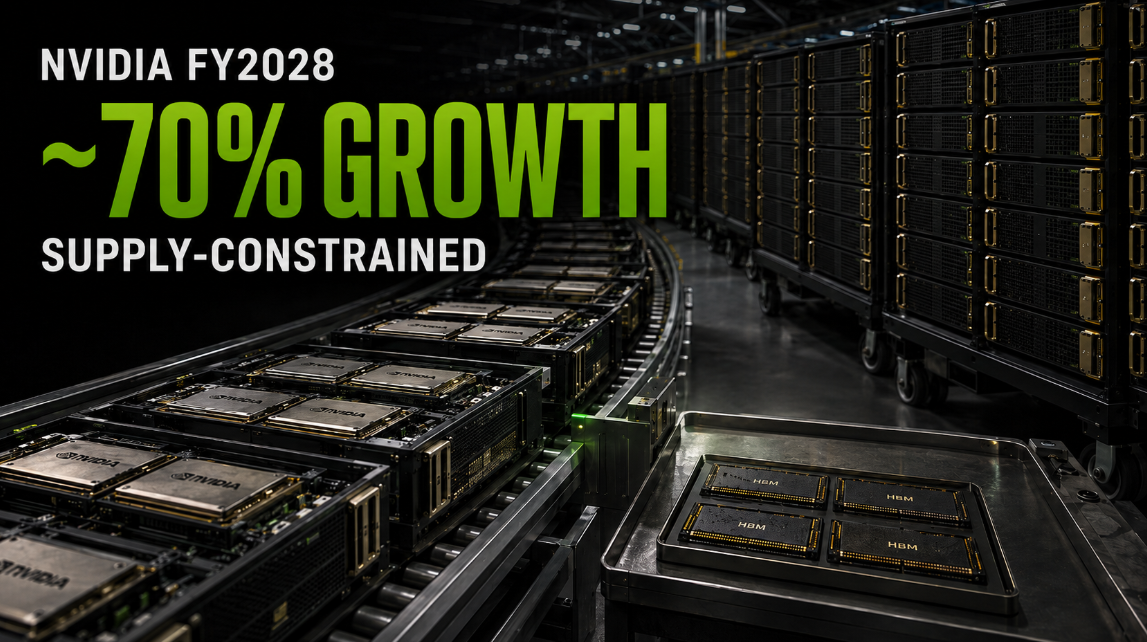
If memory producers were rapidly creating excess capacity, Nvidia’s bottleneck might be mostly a short-term procurement problem. Current industry evidence points in the other direction.
Memory-market forecasts expect the DRAM market to remain tight in 2027 as AI servers absorb more HBM and server memory while new capacity takes time to ramp. Server DRAM contract prices have also been rising sharply, reinforcing the idea that the issue is not only physical availability but supplier pricing power.
Samsung’s own results tell a similar story from the supplier side. Its memory business has benefited from strong AI demand, rising industry prices and limited capacity, while demand for server DRAM and HBM remains robust.
This does not prove that Nvidia will miss shipments. It does tell us that Nvidia is competing for memory inside a market where suppliers still have leverage.
A Small Part of the AI Profit Pool Can Move Upstream
Nvidia has captured extraordinary economics from the AI buildout because its accelerators, software ecosystem and networking platform have been difficult to substitute. Memory suppliers benefited from AI demand too, but Nvidia remained the obvious center of the trade.
A persistent memory shortage changes the economics at the margin. When memory is plentiful, another Nvidia system mainly requires Nvidia to secure a normal component input. When memory is scarce, another system may require scarce HBM allocation at a higher price.
Some of the value created by one more AI server can therefore move upstream toward whoever controls the scarce memory capacity.
That does not mean Samsung, SK hynix or Micron suddenly replace Nvidia as the main profit center of AI infrastructure. It means Nvidia may no longer be able to capture quite as much of the incremental economics without either accepting lower margins or passing more cost to customers.
The expected margin path gives us a way to test that idea. If Nvidia’s gross margin drops toward 71%–72% and then recovers as planned, the company may be successfully passing through much of the memory inflation. If margins stay lower for longer while memory pricing remains strong, suppliers may be retaining a larger share of the economics than Nvidia initially expected.
Why Can’t Nvidia Just Buy More?
Because semiconductor capacity does not appear when a purchase order is submitted.
Advanced DRAM expansion requires fab construction or conversion, equipment installation, process migration, qualification and yield improvement. HBM adds further manufacturing intensity, and allocating more wafer capacity to HBM can reduce the capacity available for other DRAM products.
Major suppliers are expanding production, but long equipment lead times and new-fab schedules mean significant supply additions do not immediately become usable memory output.
There is another complication. Nvidia is not the only company buying memory for AI accelerators. Custom chips designed by hyperscalers also need HBM and server memory.
Replacing some Nvidia GPUs with custom silicon can change who sells the accelerator. It does not necessarily remove the memory bottleneck.
The Bottleneck Will Not Stay in One Place Forever
Memory is one constraint in a much larger AI infrastructure chain. Advanced packaging, networking equipment, power generation, grid connections, cooling, data-center construction and capital can all become the limiting factor at different stages of the buildout.
Relieving the memory shortage would not make AI infrastructure unconstrained. It could simply move the bottleneck somewhere else.
That is why “memory will stop Nvidia” would be the wrong conclusion. Nvidia is still forecasting extraordinary growth, and current evidence does not suggest that memory is ending the AI cycle.
Memory has become important enough to limit the rate at which Nvidia can convert demand into shipments while simultaneously affecting the margin on those shipments.
What Would Prove This Thesis Wrong?
The cleanest test is supply. If Samsung, SK hynix and Micron increase qualified HBM and server DRAM output faster than expected, allocation pressure should ease. Nvidia would have more freedom to convert demand into shipments, weakening the quantity side of the bottleneck.
The next test is price. Memory can remain tight without becoming progressively more expensive. If DRAM and HBM pricing stabilizes or falls, Nvidia’s cost pressure could ease even before the market reaches true oversupply.
Nvidia’s own pricing is the third variable. If customers absorb higher system prices without reducing orders, the company could restore much of its margin even while memory suppliers continue charging more.
The largest reversal would be weaker AI demand. A supply bottleneck matters only while demand exceeds supply. If hyperscalers, AI labs or enterprises materially reduce infrastructure spending, Nvidia would have a different problem: enough hardware, but fewer incremental buyers.
At that point, memory would no longer be setting the ceiling on growth.
The Most Important Number May Not Be 70%
Seventy percent is the headline because it is enormous. The more interesting number may be the amount of revenue Nvidia cannot yet capture because supply is still constrained.
We cannot calculate that number from the information Nvidia has disclosed. That is precisely why the next few quarters matter.
Watch whether Nvidia continues calling supply constrained as Vera Rubin ramps. Watch whether DRAM and HBM pricing remains elevated into 2027. Watch whether gross margin rebounds from the projected 71%–72% trough toward the 72%–73% range management expects.
Those three signals answer different questions. Supply availability tells us whether Nvidia can ship more. Memory pricing tells us who has bargaining power. Gross margin tells us who is absorbing the cost.
If supply loosens and Nvidia’s margin recovers, memory will have been a painful but manageable bottleneck. If demand remains strong, supply stays tight and Nvidia’s margin struggles to recover, the AI boom will still be growing—but a larger share of the next dollar may be flowing to the companies controlling the scarce memory.
That is why Nvidia’s 70% forecast does not make the memory problem less important. It makes the bottleneck worth watching.
FAQ
Why is Nvidia supply-constrained if demand is so strong?
Because demand determines how many systems customers want, while supply determines how many Nvidia can actually deliver. Strong demand can therefore coexist with limited shipments when components such as memory remain scarce.
Does Nvidia expect 70% revenue growth in calendar 2028?
No. The forecast refers to Nvidia’s fiscal 2028, which ends in January 2028 and therefore largely overlaps calendar 2027.
Is memory the only supply constraint Nvidia faces?
No. Nvidia depends on a broader semiconductor and infrastructure supply chain. Memory matters here because it can affect both available system volume and gross margin.
Does a memory shortage mean Nvidia’s growth is ending?
No. Nvidia is still forecasting very high growth. The relevant question is whether memory limits how much of the available AI demand Nvidia can convert into revenue and how profitable those additional sales remain.
Sources
- Nvidia — Second Quarter Fiscal 2027 Financial Results
- Reuters — Nvidia Fiscal 2028 Growth and Supply Outlook
- TrendForce — 2027 DRAM Supply Outlook
- TrendForce — Server DRAM Price and Supply Outlook
- Samsung Electronics — Q2 2026 Results
Did Boeing Really Win a $131 Billion F-15 Contract? What the Number Actually Means
Did Boeing Really Win a $131 Billion F-15 Contract? What the Number Actually Means
더보기Boeing’s $131.23 billion F-15 Eagle Crest award is real, but the headline number is an IDIQ ceiling—not guaranteed revenue. Here’s what the $343,740 obligation, future orders and Boeing backlog actually tell investors.Boeing really was award
global.kkomccom.com
Meta Is Building Gigawatts of AI Compute: Is Electricity Becoming the Real Bottleneck?
Meta Is Building Gigawatts of AI Compute: Is Electricity Becoming the Real Bottleneck?
Meta has raised its 2026 capital expenditure guidance to $130B–145B while expanding its Louisiana AI campus to 5GW and backing multi-gigawatt energy agreements spanning natural gas, grid batteries, and nuclear power. While access to advanced GPUs remains
global.kkomccom.com