Google did not hand Marvell $12.2B in cash, and Marvell has $0 in guaranteed revenue. Here is what the SEC Form 8-K warrant deal actually proves.
Financial headlines went wild over Google’s "$120 billion AI chip deal" and "$12.2 billion Marvell stake." In reality, Google paid $0 in cash upfront, and Marvell was handed $0 in guaranteed orders.
The filing reveals a performance-vested customer warrant: Google only unlocks equity when it actually buys custom silicon in $500 million chunks. It proves Google is aggressively diversifying its custom chip infrastructure—not that Broadcom got fired or that $120 billion is already booked.
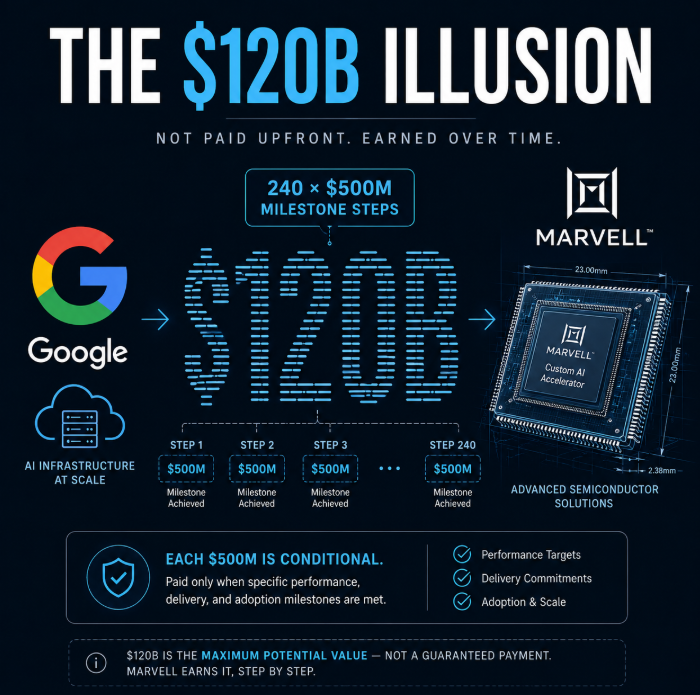
Table of Contents
Headlines exploded this week: "Google inks massive $120B chip deal," "Google takes $12.2B stake in Marvell."
If you only read the headlines, you'd think Google just wrote a blank check to corner the AI chip market and kick Broadcom to the curb.
Here is the candid reality straight from the SEC Form 8-K: Google spent $0 upfront, and Marvell is guaranteed exactly $0 in new revenue.
This isn't an acquisition. It isn't a venture stake. It’s an equity carrot—a milestone-driven commercial incentive designed to secure custom semiconductor capacity without taking balance-sheet risk.
The Math Nobody Reads: 240 Tranches and a $206.58 Strike Price
Let’s skip the hype and look at the actual mechanics filed with the SEC on August 19, 2026.
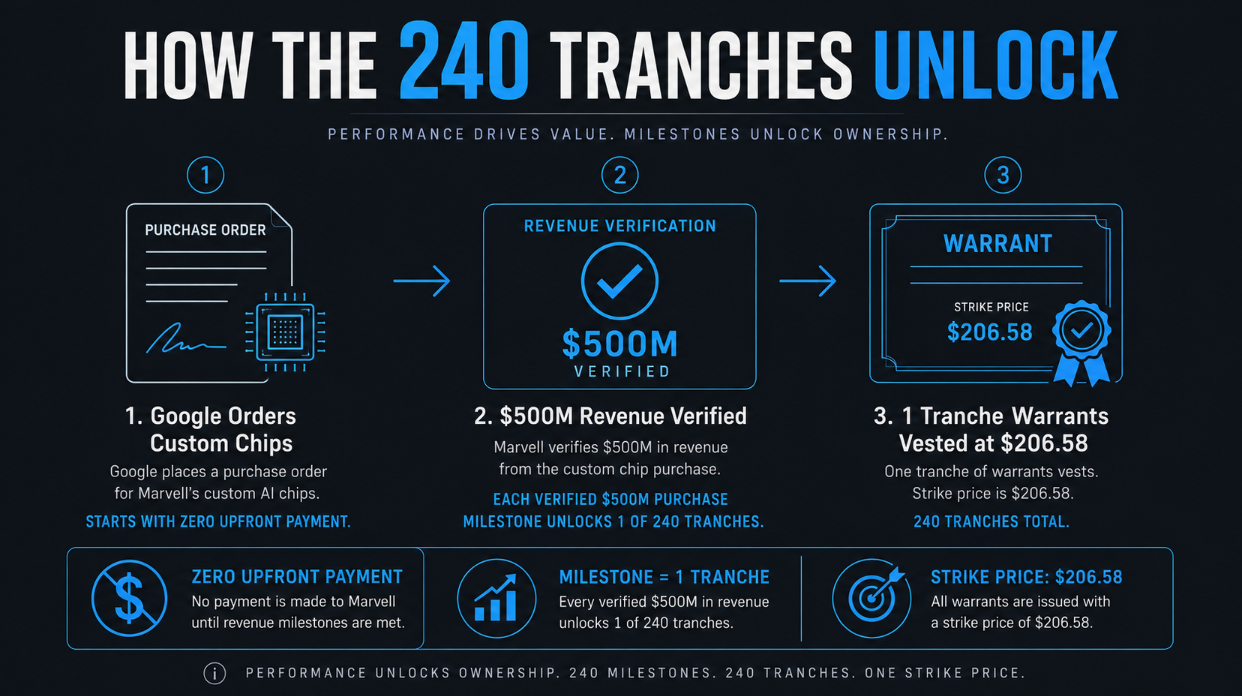
- The Asset: Google received warrants to buy up to 58,970,907 Marvell shares.
- The Strike Price: $206.58 per share. (Google has to *pay* this price to get the stock—it’s not free equity).
- The Expiration: August 18, 2033.
Google doesn't just wake up tomorrow owning a piece of Marvell. Almost the entire grant is locked behind a strict pay-to-play structure:
- The Starter Pack: ~1.36 million shares vest quarterly over Year 1.
- The 240 Milestone Tranches: The remaining 57.61 million shares are split across 240 identical tranches.
- The Trigger: Every time Marvell books $500 million in qualifying custom silicon sales from Google, one tranche unlocks.
Do the math:
$240 X $500 million = $120 billion
The headline "$120 Billion Deal" isn't a purchase order sitting in Marvell’s order book. It is the maximum spending ceiling Google must hit over the next seven years to unlock every last warrant.
| What the Market Thinks | What the Contract Actually Says |
| "Google bought a $12.2B stake" | $0 upfront cash. Google only pays if it exercises the warrants at $206.58/share. |
| "Marvell booked $120B in sales" | $0 guaranteed backlog. Purchases are purely discretionary in $500M steps. |
| "Standard equity deal" | 240-step performance lock. Spend $500M $\rightarrow$ Unlock 1 tranche. |
| "Broadcom is replaced" | Different silicon tiers. Broadcom handles main TPU compute; Marvell gets subsystems. |
What This Agreement Actually Proves
Stripping away the sensationalism doesn’t make this deal unimportant. In fact, what it actually proves is far more interesting for the semiconductor supply chain:
1. Google is Building a Moat Around Custom Subsystems
This isn't just about training chips. Google's custom silicon program has expanded into dedicated inference silicon, high-speed network interfaces (NICs), storage controllers, and near-memory accelerators. Marvell excels at optical interconnects and custom SerDes IP. Google is locking in Marvell’s top engineering talent so those engineers aren't building chips for Amazon or Microsoft.
2. Big Tech’s New Playbook: Weaponizing Purchasing Power
Designing bleeding-edge 2nm and 3nm custom ASICs requires scarce packaging slots and specialized design teams. Instead of paying higher cash margins, Google is telling Marvell: "Give us priority access and customized IP, and we’ll give you a path to massive revenue plus upside in your own stock."
3. Single-Vendor Risk is Officially Over
Relying entirely on one partner for custom AI hardware is a vulnerability no hyperscaler can afford. Google is building a multi-vendor ecosystem where different partners handle distinct pieces of the data center fabric.
What It Definitely Does NOT Prove
Don't let Wall Street narratives run wild. Here are the hard boundaries:
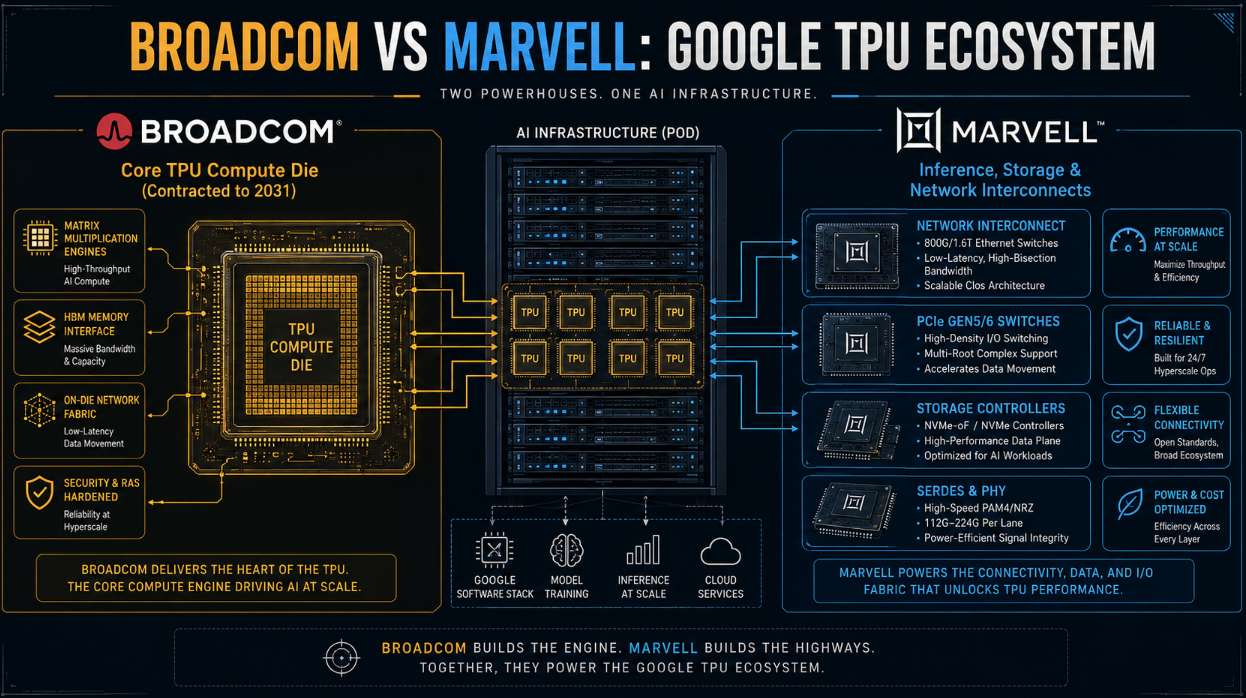
- Broadcom is NOT Fired: Broadcom’s co-design agreements covering Google’s flagship TPU compute dies extend through 2031. Marvell is securing the surrounding subsystem real estate, not kicking Broadcom out of the main computing engine.
- Marvell’s Numbers Won’t Spike Overnight: Because spending is milestone-based, Google can slow down, redesign, or pause orders whenever it wants without breaching the contract.
- Nvidia Isn't Irrelevant: Custom TPUs and Marvell ASICs run internal workloads (like Gemini) cost-effectively. But Google Cloud still needs massive fleets of merchant GPUs to satisfy external enterprise clients.
| Silicon Domain | Primary Partner | Strategic Role |
| Main TPU Compute Engine | Broadcom (Through 2031) |
Core matrix-math dies, primary training clusters, high-density TPU packaging. |
| Interface & Acceleration | Marvell (Through FY2033) |
Custom inference offload, network/storage controllers, memory interfaces. |
The Real Takeaway: How to Track the Execution
Forget the $120 billion vanity metric. If you want to know if this deal is actually working, watch these three concrete signals over the coming quarters:
- Vesting Disclosures in 10-Qs: Watch Marvell's quarterly filings for footnotes showing how many of the 240 tranches actually vested. That number tells you the real dollar volume Google took to production ($500M per tranche).
- Marvell’s Custom Gross Margins: Custom ASIC programs historically carry lower gross margins than off-the-shelf networking chips. Watch whether surging volume offsets margin compression.
- Broadcom’s Guidance Stability: As long as Broadcom’s AI custom compute revenue remains rock solid, you have definitive proof that Google’s total silicon pie is growing—not being cannibalized.
FAQ
Did Google pay $12.2 billion to buy Marvell stock?
No. Google paid nothing upfront. It received warrants that grant the right to buy shares at $206.58 each—and only after earning those warrants by purchasing custom silicon from Marvell.
Is Marvell guaranteed to make $120 billion from this?
No. $120 billion is the maximum cumulative purchase target required to unlock all 240 warrant tranches by fiscal 2033. Google has no legal obligation to spend the full amount.
Does this deal replace Broadcom in Google’s TPU supply chain?
No. Broadcom remains under contract through 2031 for core TPU compute dies. Marvell’s scope centers on surrounding subsystem controllers, inference accelerators, and memory/storage interfaces.
The USMCA Exemption Myth: Why Section 338 Hits Canadian Goods with 50% Tariffs
The USMCA Exemption Myth: Why Section 338 Hits Canadian Goods with 50% Tariffs
더보기Holding a USMCA Certificate of Origin will not block America's 50% Section 338 tariff. Learn how duty stacking overrides preferential trade rules and why 554 Canadian tariff lines are exposed. A USMCA Certificate of Origin eliminates normal baseli
global.kkomccom.com
Walmart Beat Earnings. Why Did WMT Still Drop 9%?
Walmart Beat Earnings. Why Did WMT Still Drop 9%?
더보기Walmart beat Q2 FY27 earnings and raised its full-year outlook, yet WMT fell more than 9%. The reason was simple: investors cared more about weaker U.S. sales momentum and soft Q3 guidance than the quarter Walmart had already finished. Walmart bea
global.kkomccom.com