Alphabet issued an inaugural A$5.5B Kangaroo bond to diversify funding for its $200B AI infrastructure buildout. Here is what the deal proves for tech balance sheets.
Alphabet's inaugural A$5.5 billion ($3.9 billion) Australian dollar bond issuance is a calculated diversification of its capital structure as annual AI infrastructure spending approaches $200 billion.
The transaction, which drew over A$18 billion in orders across four tranches, does not indicate a cash shortage; instead, it reflects a structural shift toward global credit market access. By tapping deep institutional liquidity pools such as Australian superannuation funds, Google is securing long-duration financing to support capital expenditure cycles without overburdening domestic credit channels.
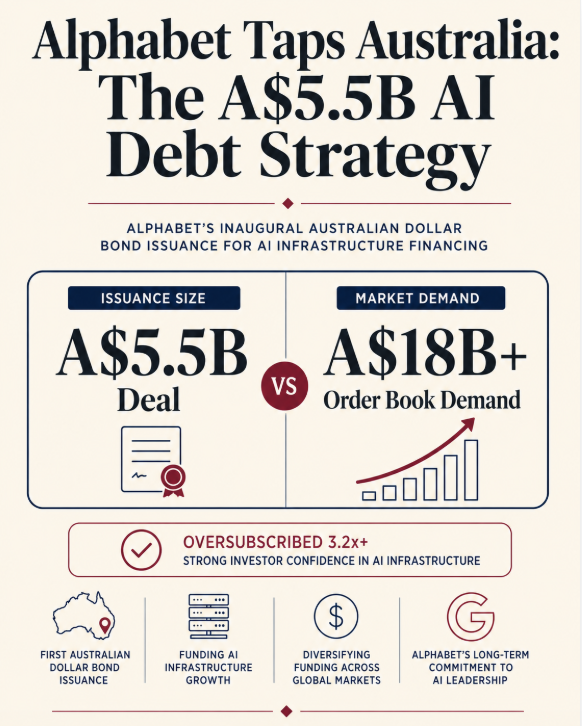
Table of Contents
When Alphabet priced its first-ever Australian dollar-denominated bond in August 2026, it marked an uncommon geographical departure for a company historically reliant on U.S. dollar corporate debt and massive operational cash flows.
The A$5.5 billion ($3.9 billion) deal—known in credit markets as a Kangaroo bond—surpassed expectations by generating an order book in excess of A$18 billion. To retail investors accustomed to viewing Big Tech balance sheets as self-funding cash engines, issuing debt in Sydney raises an immediate question: why is Google borrowing in Australian dollars?
The direct answer is capital diversification. With Alphabet raising its full-year 2026 capital expenditure guidance to between $195 billion and $205 billion, the scale of AI infrastructure spending has outgrown single-currency debt issuance. Alphabet is not running out of money; rather, it is executing a multi-currency financing playbook to access deep, non-U.S. institutional liquidity pools, optimize cross-currency borrowing spreads, and lock in long-dated maturities to match the multi-decade lifespan of AI data centers.
The Deal Breakdown: Four Tranches and A$18B in Demand
Alphabet’s transaction was structured across four distinct maturities: 3-year, 5-year, 10-year, and 20-year tranches. This spread was deliberately designed to attract both short-term bank balance sheets and long-term institutional capital, specifically Australia’s fast-growing A$3.9 trillion superannuation (pension) sector.
The final pricing compressed significantly from initial guidance due to a 3.3-times oversubscription, demonstrating substantial global appetite for AA-rated Big Tech credit outside the United States.
| Tranche Maturity | Issue Size (A$) | Coupon / Spread Structure | Primary Target Investor Base | Strategic Purpose |
| 3-Year | A$1.25 Billion | Floating Rate Note (BBSW + Spread) | Domestic Commercial Banks & Liquid Accounts | Short-term working capital & rate flexibility |
| 5-Year | A$1.50 Billion | Fixed Rate Senior Notes | Asset Managers & Regional Institutions | Core intermediate funding baseline |
| 10-Year | A$1.75 Billion | Fixed Rate Senior Notes | Domestic & International Pension Funds | AI data center asset-liability duration matching |
| 20-Year | A$1.00 Billion | Fixed Rate Senior Notes | Superannuation & Long-Duration Life Insurers | Long-life power & real estate infrastructure lock-in |
The critical detail in this structure is the inclusion of the 20-year tranche. Tapping 20-year debt in the Australian domestic market is relatively rare for foreign corporate issuers. For Alphabet, securing two decades of fixed-rate funding establishes a reliable capital base for utility-scale power agreements and custom silicon deployment that take years to yield commercial returns.
The CAPEX Reality: Why Cash Reserves Alone Are No Longer Enough
For over a decade, Big Tech funded its growth almost entirely through operating cash flow (OCF). That model is changing because the sheer scale of the generative AI infrastructure race requires capital deployment at an unprecedented velocity.
In the second quarter of 2026, Alphabet’s quarterly CAPEX exceeded $44 billion. While operating cash flows remained robust at approximately $38.5 billion, the massive infrastructure outlay resulted in a negative quarterly free cash flow (FCF) of roughly $5.9 billion.
| Financial Metric | Q2 2025 | Q2 2026 | Full-Year 2026 (Guidance / Est.) |
Balance Sheet Interpretation |
| Quarterly CAPEX | $13.2 Billion | $44.1 Billion | $195.0B – $205.0B | Infrastructure buildout accelerating |
| Operating Cash Flow (OCF) | $28.8 Billion | $38.5 Billion | $160.0B – $170.0B | Strong core profitability intact |
| Free Cash Flow (FCF) | +$15.6 Billion | -$5.9 Billion | -$25.0B to -$35.0B | Net cash generation temporarily negative |
| Total Outstanding Debt | $13.2 Billion | $51.8 Billion | Expanding via multi-currency | Shift from cash-neutral to leveraged hyperscaler |
When annual capital expenditure approaches $200 billion, relying exclusively on cash reserves or quarterly earnings would force trade-offs in other capital allocation areas, such as share repurchases, strategic acquisitions, or research spending. Debt issuance allows Alphabet to maintain its capital returns to equity shareholders while simultaneously building data centers at full speed.
Global Debt Laddering: The Strategic Shift from Dollar-Only Borrowing
If Alphabet must issue debt, why not issue exclusively in U.S. dollars?
The primary risk for any mega-cap corporate borrower is domestic market saturation. When a handful of hyperscalers—including Microsoft, Meta, and Amazon—are all issuing tens of billions in USD debt simultaneously, corporate credit spreads in the U.S. can widen.
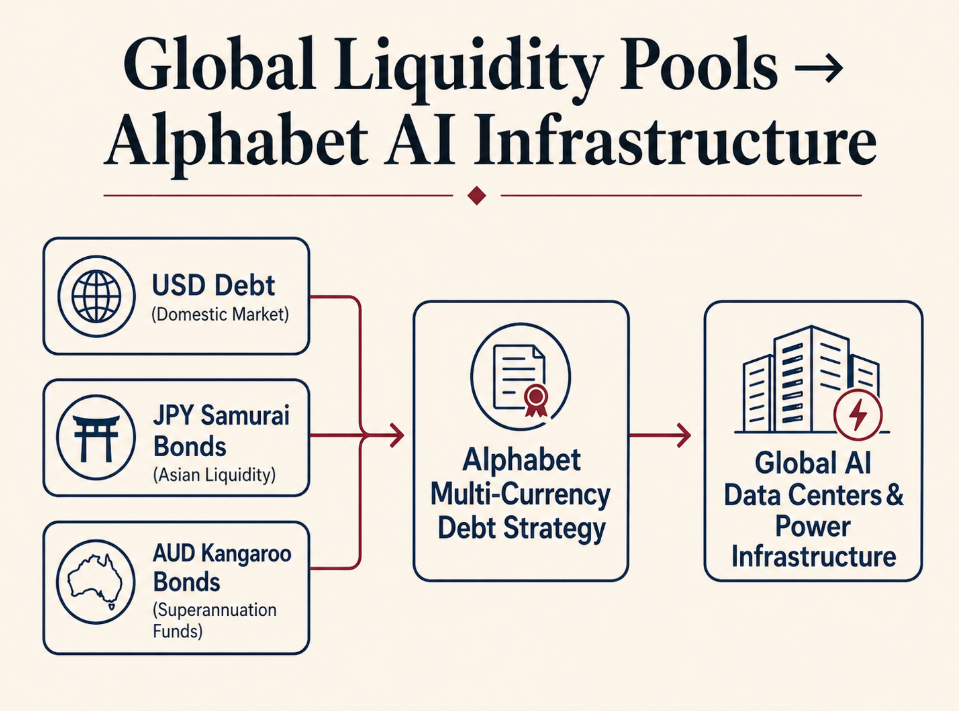
By creating secondary and tertiary borrowing channels in overseas markets, Alphabet accomplishes three structural objectives:
- Broadening the Creditor Base: Australian superannuation funds hold massive, steadily growing capital pools that are legally required to invest in high-grade fixed-income assets. Alphabet offers a rare high-yield alternative to sovereign debt.
- Arbitraging Basis Swaps: Multi-national treasuries routinely issue in foreign currencies and execute cross-currency interest rate swaps back into USD, frequently achieving a net effective borrowing cost lower than issuing directly in the domestic U.S. market.
- Currency-Matched Infrastructure Funding: As Google Cloud expands physical data center footprints and renewable energy power-purchase agreements across the Asia-Pacific region, issuing in local and regional currencies creates natural accounting hedges.
This follows Alphabet’s earlier moves into Samurai bonds (Japanese Yen) and prepares the treasury for future issuances across Europe and other mature credit hubs.
What This Deal Proves (and What It Does Not)
To evaluate this deal accurately, investors must separate verified balance sheet management from sensational headlines.
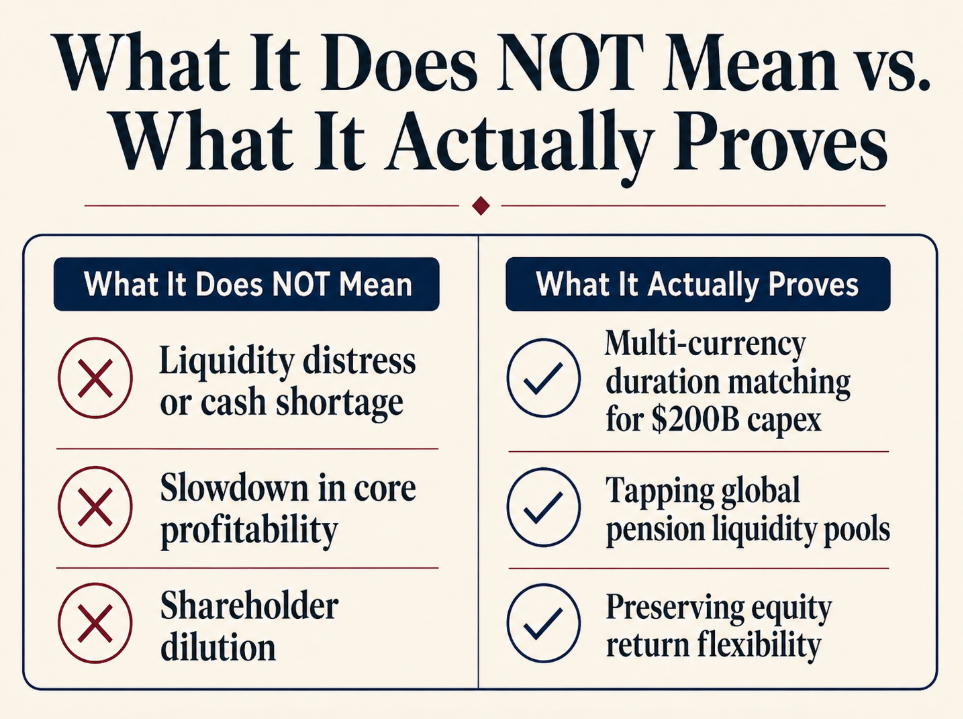
What It Proves:
- The Hyperscaler Model Has Changed: Alphabet has structurally shifted from an asset-light software business to a capital-intensive infrastructure conglomerate. Debt issuance is now a standard, continuous operational tool.
- Global Demand for Tech Debt Is Massive: The A$18 billion order book proves that global fixed-income markets view Big Tech credit risk on par with sovereign and semi-government entities.
- Capital Discipline Remains Active: Rather than accepting whatever borrowing spreads are available in New York, management is actively engineering its liability structure worldwide.
What It Does Not Prove:
- It Does NOT Prove Financial Distress: Alphabet holds tens of billions in highly liquid cash and marketable securities. Its credit ratings (AA+ / Aa2) remain intact.
- It Does NOT Mean Equity Dilution: Debt financing explicitly avoids shareholder dilution and allows management to continue its baseline dividend and buyback programs.
The Investor Decision Rule: Key Metrics to Track Next
As Big Tech debt issuances become more frequent throughout 2026 and 2027, equity and credit investors should evaluate hyperscalers using an updated set of balance sheet rules:
- Net Debt-to-EBITDA Trajectory: Track whether Alphabet’s net debt ratio remains safely below 1.0x. A controlled rise in leverage to fund productive AI infrastructure is healthy; an uncalibrated spike without corresponding revenue growth is not.
- Depreciation vs. Cloud Revenue Growth: Watch whether Google Cloud operating margins expand quickly enough to outpace the rising depreciation charges from multi-billion-dollar data center investments.
- Subsequent Currency Openings: Monitor whether Alphabet or other hyperscalers move into Eurobonds or Swiss Franc markets. Continued international debt issuance will confirm that global multi-currency funding has become permanent corporate policy.
FAQ
Q1: What is a Kangaroo bond, and why did Google use it?
A Kangaroo bond is an Australian dollar-denominated bond issued in the Australian domestic market by a non-Australian corporation. Alphabet utilized this instrument to tap the deep liquidity of Australia's institutional pension funds (superannuation funds) and diversify its funding sources outside the U.S. dollar market.
Q2: Is Alphabet issuing debt because it is running out of cash?
No. Alphabet maintains substantial cash reserves and generated over $38 billion in operating cash flow in Q2 2026 alone. However, because its annualized AI capital expenditures are projected to reach $195 billion to $205 billion, issuing investment-grade corporate debt is a more efficient way to match long-term infrastructure funding without depleting liquidity or scaling back share repurchases.
Q3: How does issuing in Australian dollars help fund U.S. data centers?
Multi-national corporations frequently issue debt in foreign currencies where institutional demand is strong, then use cross-currency swaps to convert the proceeds back into U.S. dollars at competitive net interest rates. Additionally, Alphabet operates significant international data centers and cloud infrastructure across the Asia-Pacific region, making non-USD capital directly usable for regional expansions.
Why Moderna Surged 177%: What the Phase 3 Cancer Vaccine Data Actually Proves
Why Moderna Surged 177%: What the Phase 3 Cancer Vaccine Data Actually Proves
더보기Moderna surged 177% following positive Phase 3 cancer vaccine data with Merck. Here is what the topline trial results prove, what remains unverified, and why Wall Street repriced the mRNA oncology platform.Moderna’s 177% single-day surge was not
global.kkomccom.com
Pennsylvania AI Data Center Rules 2026: Why Gov. Shapiro Ended the Fast Track
Pennsylvania AI Data Center Rules 2026: Why Gov. Shapiro Ended the Fast Track
더보기 Pennsylvania did not ban data centers. Executive Order 2026-05 ends fast-track permitting, mandates developer-funded grid upgrades, and requires local consent. Here is what it means for hyperscaler CAPEX and Amazon's $20B footprint.Pennsylvania h
global.kkomccom.com