Moderna surged 177% following positive Phase 3 cancer vaccine data with Merck. Here is what the topline trial results prove, what remains unverified, and why Wall Street repriced the mRNA oncology platform.
Moderna’s 177% single-day surge was not driven merely by the commercial potential of a single melanoma therapy, but by the first late-stage clinical validation of its individualized mRNA oncology platform.
While the Phase 3 trial co-developed with Merck successfully met primary recurrence-free survival (RFS) endpoints, detailed hazard ratios and overall survival (OS) data remain unreleased.
The resulting $40 billion addition to Moderna's market capitalization reflects a structural repricing of multi-cancer platform optionality, magnified by the rapid unwinding of historical short positions.
Table of Contents
Direct Answer: Why MRNA Surged 177% on Topline Data
Moderna’s 177% single-day share price explosion—adding approximately $40 billion in market value—represents a fundamental shift in how public markets value the company. The immediate catalyst was a positive Phase 3 topline readout for mRNA-4157 (V940), an individualized neoantigen therapy developed in partnership with Merck & Co., administered in combination with Keytruda for high-risk melanoma.
However, the scale of the market reaction far exceeds the financial value of the melanoma market alone. Analysts estimate peak annual sales for this specific melanoma indication at approximately $3 billion by 2035. The $40 billion market cap expansion demonstrates that institutional investors did not just price a single drug; they dramatically upgraded the probability of success for Moderna’s entire post-COVID mRNA pipeline.
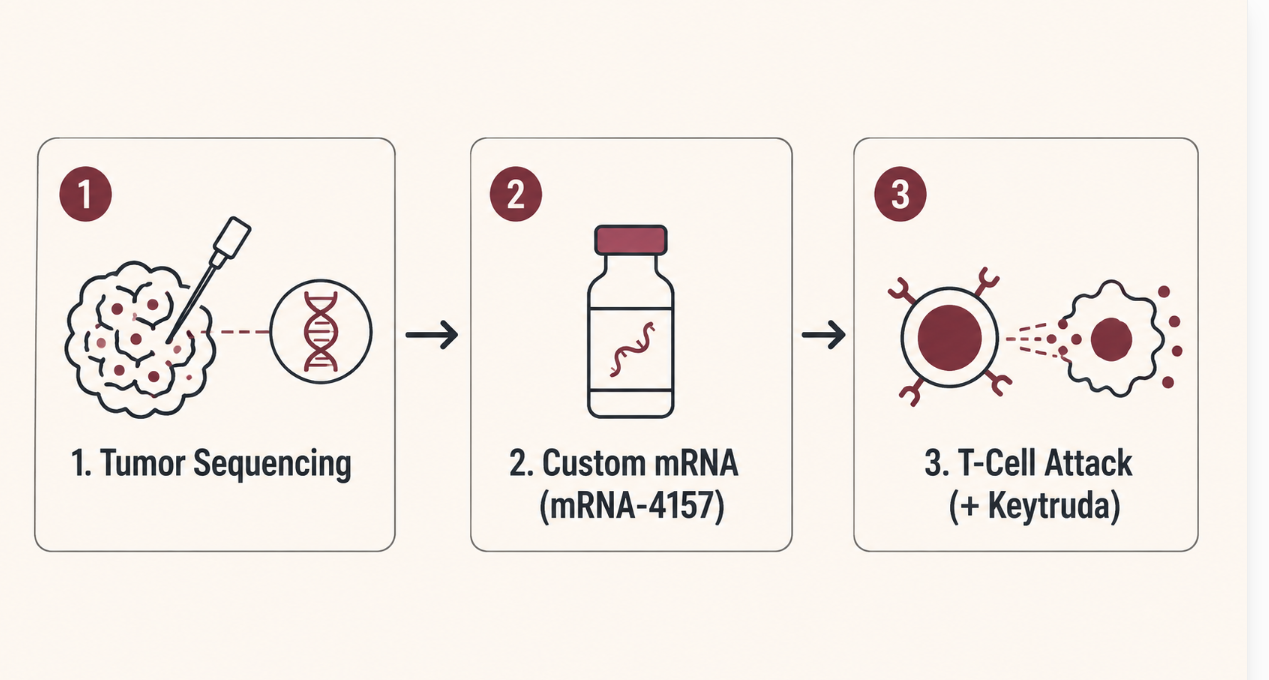
The trial provides the first late-stage clinical proof that mRNA can train the human immune system to target patient-specific cancer mutations effectively when paired with standard-of-care checkpoint inhibitors. By proving that the technology works in a randomized Phase 3 setting, Moderna transitioned overnight from a declining COVID vaccine producer into a validated oncology platform.
What the Phase 3 Melanoma Trial Proved—and What It Didn’t
To assess whether this valuation surge is sustainable, investors must separate confirmed clinical evidence from unanswered commercial and biological questions.
The Phase 3 trial evaluated mRNA-4157 plus Keytruda against Keytruda monotherapy as adjuvant treatment in patients with resected high-risk melanoma (stages III/IV). The joint announcement confirmed that the study met its primary endpoint of Recurrence-Free Survival (RFS) and its key secondary endpoint of Distant Metastasis-Free Survival (DMFS) with statistical significance.
Phase 3 Melanoma Readout — Confirmed Evidence vs. Critical Unknowns
| Clinical Parameter | Confirmed Topline Evidence | What Remains Unproven | Investor Implication |
| Primary Endpoint (RFS) | Statistically significant improvement vs. Keytruda alone | Detailed Hazard Ratio (HR) and magnitude of benefit | Clinical win confirmed, but exact therapeutic margin remains unknown |
| Distant Metastasis (DMFS) | Key secondary endpoint met with statistical significance | Duration of metastatic protection over 5+ years | Validates systemic immune response against distant recurrence |
| Overall Survival (OS) | Trend favors combination therapy | Data remains immature; no statistically significant OS proof yet | Long-term survival advantage requires further trial maturation |
| Regulatory Status | Phase 3 topline success supports BLA/accelerated pathways | Final FDA/EMA approval decisions not yet granted | Execution and review timeline risk remains active |
| Manufacturing Scale | Custom mRNA synthesis viable for trial cohorts | Commercial-scale turnaround time and unit gross margins | Production bottlenecks could cap commercial margins |
While the topline win is unequivocal, the absence of granular data is notable. The joint release did not disclose the specific Hazard Ratio (HR), making it impossible to calculate the precise percentage reduction in recurrence risk compared to Phase 2b data. Furthermore, Overall Survival (OS)—the gold standard for oncology reimbursement—remains immature.
The Scale Check: A $3B Market vs. a $40B Market Cap Surge
A standard discounted cash flow (DCF) model based strictly on adjuvant melanoma cannot justify a $40 billion increase in enterprise value.
Even assuming a favorable 50/50 profit split with Merck, a $3 billion global peak sales projection in melanoma would generate roughly $1.5 billion in annual top-line revenue for Moderna. At standard biotechnology valuation multiples, a single de-risked asset of this size typically commands $8 billion to $12 billion in market value.
Deconstructing the +$40B Surge: Single Indication vs. Platform Value
| Valuation Component | Estimated Value Impact | Underlying Driver | Valuation Durability |
| Melanoma Indication | +$8B to $12B | Direct cash flows from ~$3B peak sales projection | High (anchored by Phase 3 data) |
| Platform Optionality | +$18B to $22B | Repricing probability of success in NSCLC, RCC, and bladder cancer | Medium (contingent on future trial readouts) |
| Technical Short Squeeze | +$8B to $12B | Rapid covering of elevated short interest post-COVID decline | Low (vulnerable to near-term mean reversion) |
The remaining value reflects the market pricing an expanded "platform multiple." If individualized mRNA vaccines succeed in non-small cell lung cancer (NSCLC), renal cell carcinoma (RCC), and cutaneous squamous cell carcinoma, Moderna’s addressable oncology market expands from $3 billion to over $30 billion annually.
Short Squeeze vs. Fundamental Re-Rating: The Real Driver
The extreme velocity of the 177% move was intensified by positioning dynamics. Prior to the readout, Moderna was heavily shorted due to deteriorating COVID vaccine sales, excess manufacturing capacity, and high research and development burn rates.
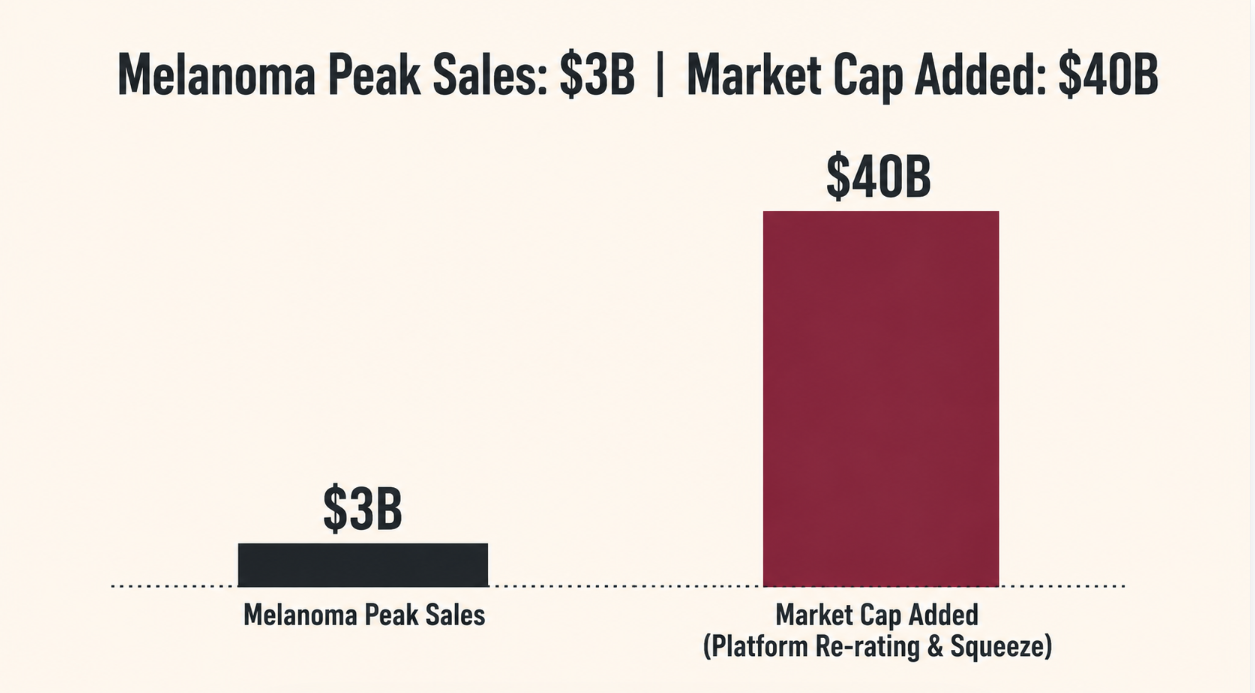
When the topline announcement crossed the wire, institutional short-sellers were forced to cover aggressively into a liquidity vacuum. This technical dynamic amplified what would have been a 40% to 60% fundamental re-rating into a historic triple-digit squeeze.
Investors should recognize that while the short squeeze created the violent opening spike, institutional buying subsequently stabilized the stock at higher levels, confirming that long-only healthcare funds stepped in to reprice the pipeline.
Counterevidence: The Hidden Risks Behind the Headline
Despite the breakthrough nature of the data, several critical headwinds could moderate Moderna's valuation in the quarters ahead:
- Turnaround Time and Logistics: Individualized neoantigen therapy requires biopsying the patient’s tumor, sequencing DNA/RNA, identifying up to 34 patient-specific neoantigens, and manufacturing a custom mRNA vial. If manufacturing turnaround exceeds six to eight weeks, real-world clinical adoption could lag trial expectations.
- Commercial Pricing and Reimbursement: Personalized batch manufacturing carries significantly higher cost of goods sold (COGS) than standard off-the-shelf monoclonal antibodies. Premium pricing will face intense scrutiny from commercial payers without mature Overall Survival data.
- Tumor Mutational Burden (TMB) Limits: Melanoma has one of the highest mutation rates among all solid tumors, making it an ideal target for neoantigen priming. Translating this efficacy to "cold" tumors with lower mutational burdens (such as prostate or pancreatic cancer) remains unproven.
What to Watch Next: The Milestones That Will Test This Valuation
To determine whether Moderna retains its expanded market capitalization, investors should monitor four verifiable catalysts:
- Detailed Phase 3 Presentation (Upcoming ASCO or ESMO): Full publication of the Hazard Ratio, subgroup analysis by PD-L1 expression, and updated OS Kaplan-Meier curves.
- FDA Filing and PDUFA Timelines: Confirmation of whether the FDA will accept an accelerated approval pathway based on RFS or require additional confirmatory follow-up.
- Expansion into Non-Small Cell Lung Cancer (NSCLC): Early Phase 2/3 enrollment milestones and preliminary response rates in lung cancer, which represent the largest commercial prize in solid tumor oncology.
- Manufacturing Turnaround Metrics: Disclosures regarding Moderna’s automated manufacturing facilities in Massachusetts and the United Kingdom, specifically targeting sub-30-day needle-to-needle delivery times.
FAQ
Does this Phase 3 trial mean the Moderna cancer vaccine is FDA approved?
No. Meeting the primary endpoints in a Phase 3 trial is the critical prerequisite for regulatory submission, but Moderna and Merck must still file a Biologics License Application (BLA) and undergo formal FDA review before commercialization.
Why is Moderna’s cancer vaccine called "individualized"?
Unlike standard vaccines, mRNA-4157 is custom-designed for each patient. Scientists sequence the patient's specific tumor mutations to identify up to 34 unique neoantigens, creating a personalized mRNA sequence tailored exclusively to that individual's cancer.
How does mRNA-4157 differ from Merck’s Keytruda?
Keytruda is a checkpoint inhibitor that removes the "brakes" preventing the immune system from attacking cancer cells. mRNA-4157 acts as the "accelerator" and "steering wheel" by actively training T-cells to identify and destroy cells expressing the patient's specific tumor mutations.
Pennsylvania AI Data Center Rules 2026: Why Gov. Shapiro Ended the Fast Track
Pennsylvania AI Data Center Rules 2026: Why Gov. Shapiro Ended the Fast Track
더보기 Pennsylvania did not ban data centers. Executive Order 2026-05 ends fast-track permitting, mandates developer-funded grid upgrades, and requires local consent. Here is what it means for hyperscaler CAPEX and Amazon's $20B footprint.Pennsylvania h
global.kkomccom.com