Boeing’s $131.23 billion F-15 Eagle Crest award is real, but the headline number is an IDIQ ceiling—not guaranteed revenue. Here’s what the $343,740 obligation, future orders and Boeing backlog actually tell investors.
Boeing really was awarded an F-15 Eagle Crest contract with a $131.23 billion ceiling. But that ceiling is not the same thing as $131.23 billion of aircraft orders, funded backlog or future revenue. At award, the government said $343,740 in FY2026 R&D funds was being obligated, while Air Force IDIQ rules indicate that an award-time obligation is tied to the contract’s minimum quantity. The real question for investors is therefore how much work actually gets ordered underneath the ceiling.
On August 24, the U.S. Department of War announced what looked like an extraordinary win for Boeing: a $131.23 billion F-15 Eagle Crest contract. The number is real, but the easiest interpretation of it is wrong. Boeing did not suddenly receive $131.23 billion of F-15 orders, and investors should not assume that amount will automatically become backlog or revenue.
The wording in the official announcement matters. Boeing received a $131,230,000,000-ceiling indefinite-delivery/indefinite-quantity contract. In the same announcement, the government said just $343,740 in fiscal 2026 research, development, test and evaluation funds were being obligated at the time of award. Those two numbers can coexist because they describe different stages of the same contracting structure.
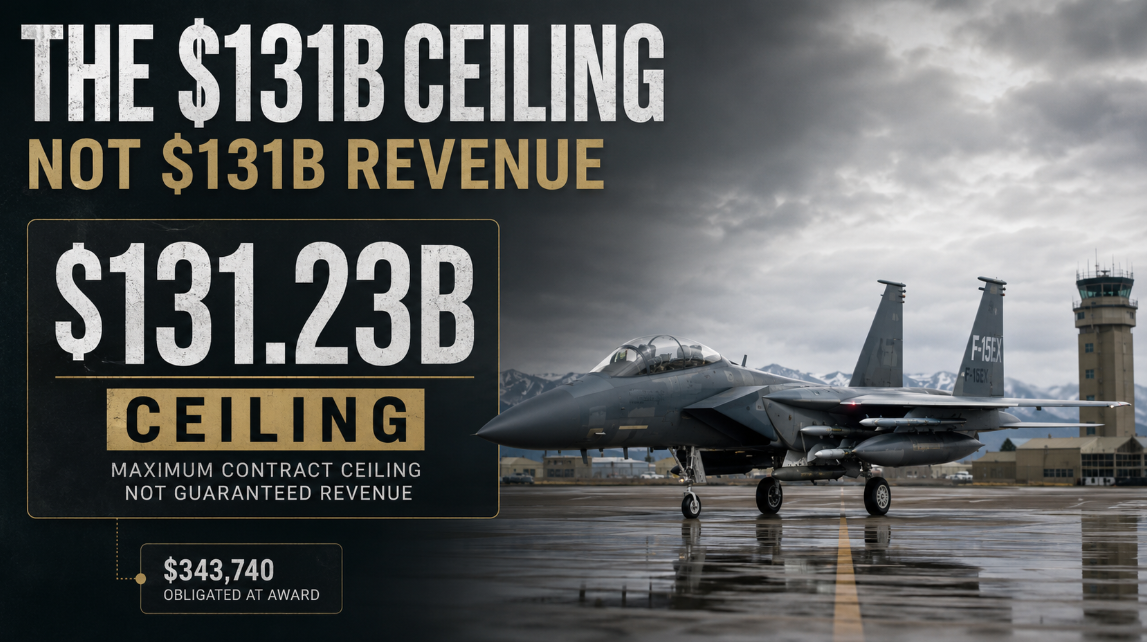
Table of Contents
A $131 Billion Contract Is Not the Same as a $131 Billion Order
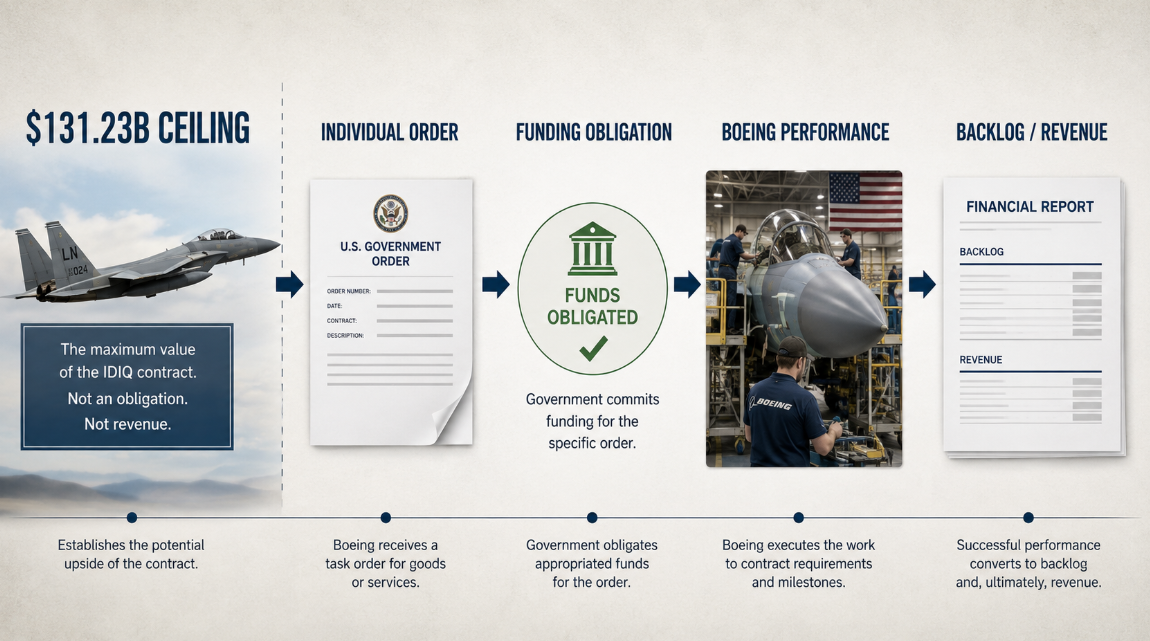
The simplest way to understand the award is to start with the term IDIQ, or indefinite-delivery/indefinite-quantity. The federal acquisition rules use this structure when the government knows what type of products or services it will need but does not yet know exactly how much it will buy or when it will need each delivery. Instead of purchasing the entire maximum amount on day one, the government places individual orders as requirements materialize.
FAR 16.504 requires an IDIQ contract to contain both a minimum and a maximum. The government must order at least the stated minimum, while the contractor must be prepared to fulfill additional orders up to the maximum if they are issued. FAR 52.216-22 is even more explicit: quantities stated in the schedule are estimates, and actual delivery or performance occurs through authorized orders.
IDIQ ceiling → orders → funding obligations → Boeing performance → backlog/revenue
The stages are related, but they are not interchangeable.
| Number or stage | What it actually tells us | What it does not tell us |
| $131.23B ceiling | Maximum potential value permitted under the IDIQ vehicle | That $131.23B has been ordered |
| Contract minimum | Amount the government is committed to order under the IDIQ | How much will ultimately be ordered |
| Task / delivery order | A specific requirement has been placed under the contract | That the entire IDIQ ceiling will be used |
| Funding obligation | Government funds have been legally committed | That Boeing has already earned the revenue |
| Backlog | Future work meeting Boeing's backlog criteria | The full maximum value of every contract vehicle |
| Revenue | Value recognized as Boeing performs under the applicable accounting rules | Headline contract ceiling |
The distinction sounds technical, but it completely changes the economic meaning of the $131.23 billion headline.
So What Exactly Is the $343,740?
This is the more interesting number. The contract announcement says $343,740 of FY2026 RDT&E funds were being obligated at the time of award. The announcement itself does not explicitly say, “$343,740 is the guaranteed minimum,” so it would be too aggressive to present that exact label as a directly stated fact from the award notice.
There is, however, another piece of evidence. Department of the Air Force acquisition procedures state that when an IDIQ contract is executed, an obligation should be recorded through a task or delivery order for the cost or price of the minimum quantity specified in the contract. The broader FAR also says the government's obligation under an indefinite-quantity contract is limited to the specified minimum.
That makes the $343,740 award-time obligation highly relevant. It strongly suggests that the initial obligation is connected to the IDIQ's minimum-order requirement, but the public award notice does not give us the contract Schedule or explicitly identify $343,740 as the stated minimum. Without that underlying document or initial order, I would keep one small qualification in the wording rather than turn an inference into a confirmed contract term.
The useful conclusion is still clear: $131.23 billion is the outer ceiling, while the amount economically committed at the starting line is dramatically smaller. The distance between those figures can only be filled by future orders.
Why the Huge Ceiling Still Matters
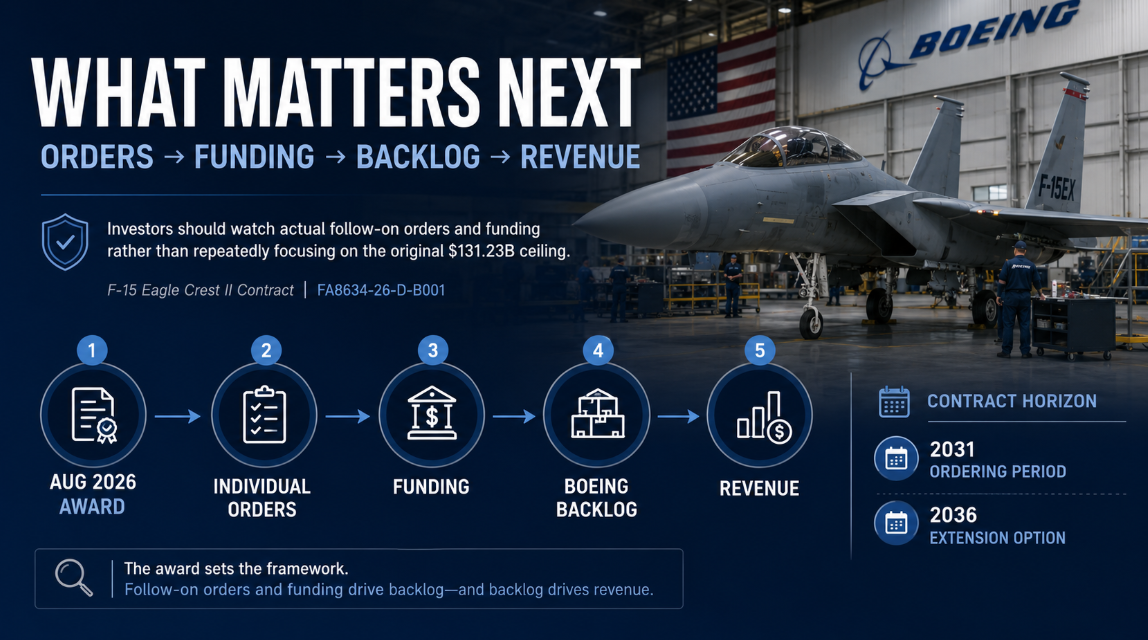
It would be just as misleading to swing to the opposite extreme and call this a “$343,740 contract.” Eagle Crest is not designed around a single aircraft purchase. The official award covers aircraft production, systems integration, modernization, upgrades, retrofits, sustainment and the establishment of organic depot maintenance capabilities. The initial ordering period runs through August 24, 2031, with an option to extend it through August 24, 2036, while work may continue through August 2037.
The contract also contemplates Foreign Military Sales involving Japan, Israel, Saudi Arabia, South Korea, Singapore, Indonesia and Poland, and it was awarded to Boeing on a sole-source basis. That does not mean all seven countries have placed new orders worth some portion of $131.23 billion. It means the Eagle Crest vehicle has been structured broadly enough to accommodate substantial future U.S. and international F-15 work if those requirements become real orders.
That has strategic value for Boeing. A long-lived contracting vehicle can make it easier for future production, upgrades and sustainment work to flow through the F-15 franchise without treating every potential requirement as a completely new contracting structure. The mistake is not assigning value to the IDIQ; the mistake is assigning the entire ceiling the same economic weight as funded work.
Boeing's Own Backlog Numbers Show Why the Difference Matters
This is where the contract structure becomes an investor question rather than just a procurement question. At June 30, 2026—before Eagle Crest was announced—Boeing reported $715.261 billion of total backlog, including $85.322 billion at Defense, Space & Security. It broke the company total into $674.506 billion of contractual backlog and $40.755 billion of unobligated backlog.
More importantly, Boeing explains what those categories mean. Its contractual backlog excludes U.S. and foreign government contract funding that has not yet been obligated, while unobligated backlog can include definitive government contracts for which funding has not yet been authorized. In other words, even Boeing's reported backlog already recognizes that a government contract can exist at several different levels of economic commitment.
That is why adding $131.23 billion directly to Boeing's backlog would be the wrong calculation. The award happened after the June reporting date anyway, but even in the next filing the relevant question will not be whether Boeing has a contract with a $131.23 billion ceiling. We already know that. The question is how much Eagle Crest work meets Boeing's actual backlog recognition criteria as orders and funding accumulate.
This is also where the article becomes more useful than simply saying, “IDIQ ceilings are not guaranteed revenue.” The harder question is how far down the chain the money has actually moved.
How Much Should Investors Count Today?
For now, I would separate strategic opportunity from committed economic value. The strategic opportunity is substantial. Boeing controls a sole-source F-15 contracting vehicle with a very large ceiling, broad program scope, a multiyear ordering period and potential international work. That gives the company a meaningful channel through which future F-15 demand can become business.
The committed economic value is much narrower today. We have the award, the maximum ceiling and the $343,740 award-time obligation. What we do not yet have is anything close to $131.23 billion of individual funded orders.
That distinction also avoids two opposite mistakes. Calling Eagle Crest a guaranteed $131 billion revenue win greatly overstates what has been committed. Dismissing it as essentially a $343,740 contract ignores the strategic value of a decade-scale procurement vehicle that may absorb future aircraft, modernization and sustainment requirements.
The answer sits between those extremes.
The Next Numbers Matter More Than the Headline Number
From here, the evidence investors need is fairly straightforward. First, watch for task and delivery orders issued under contract FA8634-26-D-B001. Those orders will show how quickly potential requirements are becoming actual procurement actions.
Second, look at the funding attached to those orders. A large order with meaningful obligations tells us considerably more about economic commitment than a large ceiling by itself.
Third, watch Boeing's future Defense, Space & Security backlog disclosures. The next filings can show whether new F-15 work is becoming material enough to change reported future business, while Boeing's distinction between contractual and unobligated backlog will help show how far that work has progressed financially.
Finally, the countries named in the Foreign Military Sales portion of Eagle Crest should be treated as potential users of the vehicle, not as seven confirmed new aircraft orders. Actual FMS approvals, procurement decisions and orders will determine how much international value eventually flows through the contract.
So, Did Boeing Really Win a $131 Billion F-15 Contract?
Yes—but the word ceiling belongs in the answer. Boeing really did receive an F-15 Eagle Crest IDIQ contract with a maximum ceiling of $131.23 billion. That is a significant strategic award and creates room for a very large amount of future F-15 work, but it does not mean $131.23 billion has already been ordered, funded, added to backlog or earned as revenue.
The $343,740 figure shows how small the award-time obligation was relative to that ceiling, while Air Force IDIQ procedures suggest that award-time funding is closely tied to the contract's required minimum. Future orders will determine whether the enormous gap between the starting obligation and the ceiling ever becomes economically meaningful.
Watch the orders underneath the ceiling, not the ceiling by itself.
FAQ
Did Boeing receive $131.23 billion from the U.S. government?
No. Boeing received an IDIQ contract with a maximum ceiling of $131.23 billion. The government places individual requirements under an IDIQ through subsequent orders, and the maximum ceiling is not itself a purchase of the full amount.
Is $343,740 the guaranteed minimum of the Boeing contract?
The public award notice does not explicitly identify $343,740 as the contract's stated minimum; it identifies that amount as FY2026 RDT&E funding obligated at award. Air Force IDIQ procedures, however, say an obligation should be recorded at contract execution through an order covering the minimum quantity, which makes a connection between the two highly plausible. The underlying contract Schedule or initial order would be needed to state the exact minimum without qualification.
Will Boeing put the entire $131.23 billion into backlog?
That should not be assumed. Boeing's own disclosures distinguish contractual backlog from unobligated government funding, so the IDIQ ceiling itself should not be treated as equivalent to reported backlog.
What should investors watch next?
The most useful evidence will be individual orders issued under Eagle Crest, the funding obligated to those orders and subsequent changes in Boeing Defense, Space & Security backlog. Those numbers will show how much of the contract's potential is becoming actual economic activity.
Sources
- U.S. Department of War — Contracts for August 24, 2026
- Federal Acquisition Regulation — FAR Subpart 16.5
- Department of the Air Force FAR Supplement — 5316.504 Indefinite-Quantity Contracts
- Boeing Form 10-Q — June 30, 2026
Meta Is Building Gigawatts of AI Compute: Is Electricity Becoming the Real Bottleneck?
Meta Is Building Gigawatts of AI Compute: Is Electricity Becoming the Real Bottleneck?
Meta has raised its 2026 capital expenditure guidance to $130B–145B while expanding its Louisiana AI campus to 5GW and backing multi-gigawatt energy agreements spanning natural gas, grid batteries, and nuclear power. While access to advanced GPUs remains
global.kkomccom.com
Foundayo Costs a Fraction of Mounjaro. Is Eli Lilly Expanding the Market or Cannibalizing It?
Foundayo Costs a Fraction of Mounjaro. Is Eli Lilly Expanding the Market or Cannibalizing It?
더보기Eli Lilly’s oral GLP-1 Foundayo enters the market at a fraction of Mounjaro’s price. Discover whether this pill expands the obesity market or risks cannibalizing premium injections. Eli Lilly’s newly approved oral GLP-1, Foundayo (orforglipr
global.kkomccom.com