Pennsylvania did not ban data centers. Executive Order 2026-05 ends fast-track permitting, mandates developer-funded grid upgrades, and requires local consent. Here is what it means for hyperscaler CAPEX and Amazon's $20B footprint.
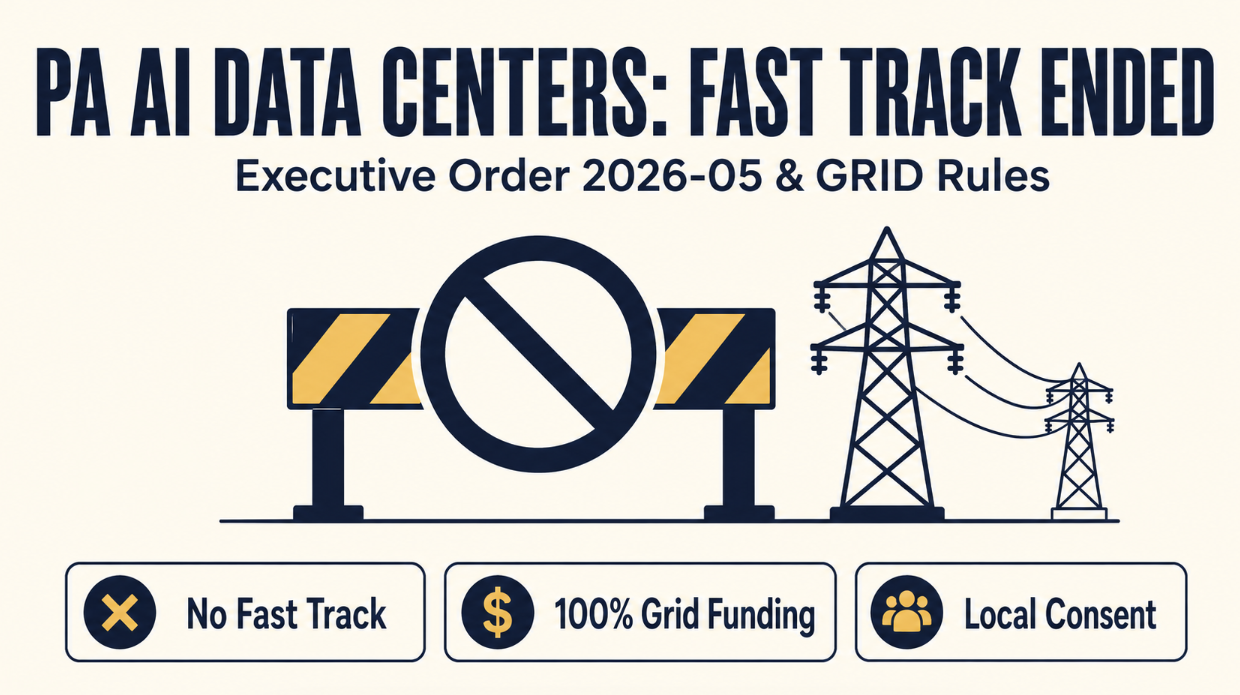
Pennsylvania has not enacted a ban on AI data centers. Under Executive Order 2026-05 signed on August 18, 2026, Governor Josh Shapiro officially excluded commercial data centers from expedited state permitting, mandated enforceable power-cost self-funding (the GRID standard), and instituted mandatory local municipal approval.
For hyperscalers like Amazon executing multi-billion-dollar buildouts, the order transforms project risk from raw power procurement to extended permitting lead times and localized infrastructure capital expenditure.
Table of Contents
FINAL ENGLISH ARTICLE
Rumors that Pennsylvania abruptly banned AI data center construction have triggered sharp questions across capital markets, particularly given the state's aggressive campaign to attract tens of billions in tech infrastructure.
The reality is narrower, but structurally significant for infrastructure investors: Pennsylvania did not ban data centers. Instead, Governor Josh Shapiro signed Executive Order 2026-05, fundamentally dismantling the state’s fast-track permitting regime for commercial data centers.
The new directive replaces blanket state incentives with rigorous local consent mandates, transparent community disclosures, and strict grid-cost allocation rules designed to shield residential utility ratepayers.
The Direct Answer: What Executive Order 2026-05 Actually Changes
The core objective of Executive Order 2026-05 is to prevent speculative, under-capitalized data center developments from locking up regional power capacity while forcing local communities to bear the financial burden of grid reinforcements.
Under the new administrative framework:
- Fast-Track Permitting Is Terminated: Commercial data center projects exceeding critical load thresholds are no longer eligible for expedited state reviews under the PA SITES program or Governor’s Action Team coordination.
- The "GRID" Cost-Allocation Standard Is Enacted: Developers must legally commit to funding their own generation capacity, dedicated substations, or localized transmission enhancements so utility rate bases remain unaffected.
- Local Municipal Consent Is Mandatory: The Pennsylvania Department of Environmental Protection (DEP) will not process state environmental and air permits until a project secures full zoning and land-use approvals from local township supervisors.
- Public Non-Disclosure Agreements (NDAs) Are Prohibited: State and municipal agencies are barred from entering into NDAs with hyperscalers or developers, eliminating confidential utility and tax negotiations.
The Three Pillars of Pennsylvania’s New Data Center Policy
To understand the operational friction this introduces for hyperscaler engineering teams, investors must look at the specific administrative mechanisms embedded in the order.
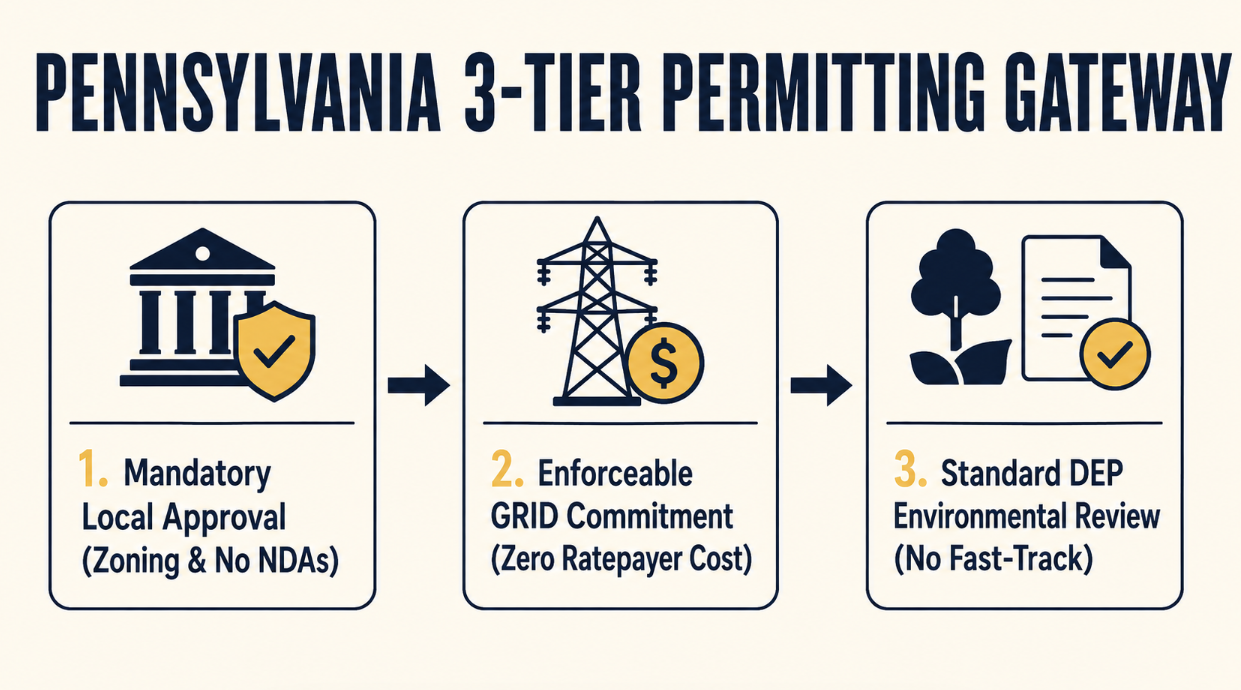
Pennsylvania’s 3-Tier Permitting Sequence (Post-EO 2026-05)
- Gate 1 — Local Municipality: Mandatory public zoning and land-use approval (All municipal NDAs strictly prohibited)
- Gate 2 — State Administration: Enforceable GRID power commitment (100% developer-funded, zero ratepayer shift)
- Gate 3 — Environmental Agency: Standard DEP environmental review (Standard sequential queue, no fast-track expediting)
The state’s revised screening process operates across three distinct gates:
1. Removal from Expedited State Channels
Previously, major capital projects could leverage dedicated ombudsmen through the PA SITES (Pennsylvania Strategic Investments to Easily Expedite Site Development) program to compress environmental permit review timelines from 18 months down to several weeks. Executive Order 2026-05 explicitly carves commercial computing facilities out of this pipeline. Data centers must now go through standard, sequential environmental review queues.
2. The GRID Principles: Developer-Funded Power
The order codifies the "Grid Reliability, Infrastructure, and Development" (GRID) framework. Before breaking ground, a developer must present a binding power-sourcing plan verified by the state and regional transmission operators. If a proposed campus requires transmission line reconductoring or new substation hardware, the developer must pay 100% of those capital improvements upfront rather than rolling them into general utility rate cases.
3. Community Pre-Approval and Transparency
A major friction point in recent months has been confidential negotiations between tech developers and local economic development boards. The executive order prohibits municipal officials from signing NDAs regarding public resource use, wastewater discharge, and municipal water allocations. Furthermore, DEP review will be stayed entirely until local zoning permits are formally granted.
Regulatory Comparison: Before vs. After EO 2026-05
| Regulatory Parameter |
Prior Framework (Pre-August 2026) |
Executive Order 2026-05 Framework |
Impact on Developer Execution |
| Permitting Speed | Expedited state pipeline (Fast-Track / PA SITES) | Standard sequential review queues | Adds 6 to 14 months to permitting lead times |
| Grid Upgrade Costs | Shared or disputed through utility rate cases | 100% direct developer-funded allocation (GRID standard) | Increases upfront project CAPEX requirements |
| Local Government Role | State support often preempted local zoning delays | State review stayed until local approvals are secured | Elevates municipal zoning risk and public scrutiny |
| Transparency & NDAs | Standard commercial NDAs allowed with municipalities | Government NDAs explicitly prohibited | Eliminates confidential utility and water negotiations |
| Speculative Siting | Low barrier to land banking and queue hoarding | Requires binding off-take and power validation upfront | Filters out speculative, under-capitalized developers |
The table above highlights that the policy does not close Pennsylvania's borders to cloud computing. Instead, it systematically eliminates the cost-subsidy arbitrage that developers previously relied upon.
Impact on Hyperscalers: Assessing Amazon’s $20 Billion Commitment
The natural question for public equity investors is whether massive announced buildouts—most notably Amazon Web Services’ (AWS) $20 billion long-term commitment in Pennsylvania—are now in jeopardy.
The short answer is no, but execution schedules and capital allocations will adjust.
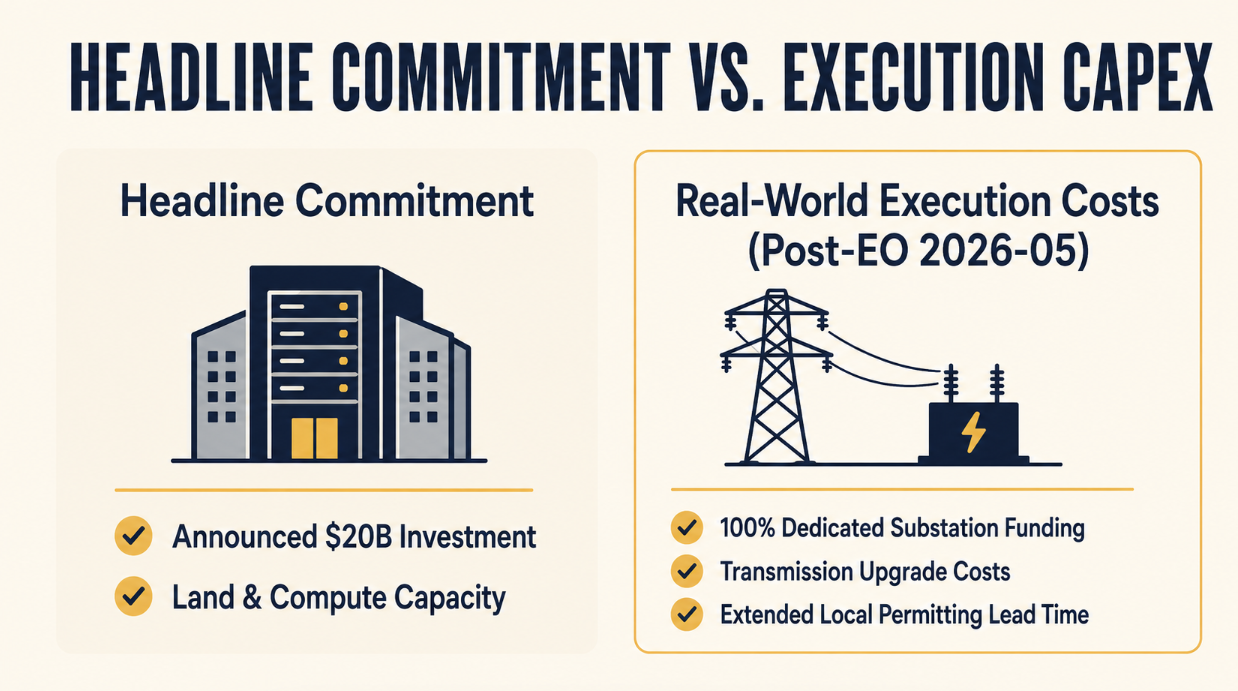
Hyperscaler projects in Pennsylvania generally split into two distinct models, each experiencing the new rules differently:
- Behind-the-Meter Nuclear Co-Location (e.g., Talen Energy / Susquehanna): Projects physically tied to existing nuclear generation assets bypass some direct grid interconnection transmission constraints. However, they remain exposed to regulatory friction regarding off-grid power diversion tariffs (FERC/PJM) and local water permit scrutiny.
- Traditional Grid-Connected Campuses (e.g., Falls Township / Keystone Trade Center): These projects face the full weight of EO 2026-05. Developers must now prove to PJM and the Pennsylvania Public Utility Commission (PUC) that massive multi-hundred-megawatt loads will not trigger locational marginal price spikes or transmission overloads for neighboring manufacturing and residential customers.
| Development Model | Exposure to EO 2026-05 | Primary Operational Risk | CAPEX & Schedule Implication |
| Nuclear Co-Located (Behind-the-Meter) | Moderate | Federal transmission tariff rulings (FERC) & local water discharge permits | Minor timeline adjustments; stable baseline unit economics |
| Grid-Connected Hyperscale (AWS, MSFT) | High | Mandatory municipal approvals & 100% GRID infrastructure cost allocation | 6–12 month permitting extension; higher upfront balance-sheet deployment |
| Speculative / Merchant AI Campus | Critical | Inability to clear financial hurdles without public subsidies or fast-track waivers | High cancellation rate; rapid site rationalization |
As outlined in the matrix, the primary casualty of the executive order is not hyperscale balance sheets, but speculative development. Well-funded players with strong balance sheets can absorb dedicated substation costs; speculative land developers without signed tenant commitments will likely exit the state.
Siting Dynamics: Power Availability vs. Permitting Certainty
For two years, the AI infrastructure narrative focused almost exclusively on power generation availability: Can a developer find 500 megawatts of clean energy?
Pennsylvania’s regulatory pivot proves that the bottleneck has shifted from power generation to permitting, zoning, and interconnection cost-allocation.
The Siting Shift: Power Bottleneck $\rightarrow$ Permitting Bottleneck
- Previous Playbook: Secure Power Capacity $\rightarrow$ Fast-Track State Permit $\rightarrow$ Groundbreaking
- 2026 Playbook: Secure Power $\rightarrow$ Fund 100% Grid Upgrades $\rightarrow$ Secure Local Consent -> Standard Review Queue
When states face pushback over escalating consumer electricity rates, governors will protect residential ratepayer bases. Pennsylvania is not an outlier; it is an early mover in standardizing ratepayer protection guardrails that other PJM states (such as Virginia, Maryland, and Ohio) are actively evaluating.
What to Watch Next
Investors tracking AI infrastructure deployments, utility capital expenditure programs, and hyperscaler CAPEX efficiency should monitor three specific catalysts:
- Pennsylvania DEP Permitting Guidelines: The formal publication of technical guidance clarifying how developers can calculate and certify compliance with the "GRID" zero-ratepayer-impact rule.
- Local Municipal Board Votes in Bucks and Luzerne Counties: How township supervisors exercise their newfound absolute gating authority over pending hyperscaler land-development plans.
- PJM Interconnection Queue Cost-Allocation Filings: Precedents established by PJM and FERC regarding the exact cost splits for network upgrades triggered by multi-gigawatt computing clusters.
FAQ
Did Pennsylvania completely ban AI data center construction?
No. Pennsylvania did not ban data centers. Executive Order 2026-05 terminated the state’s fast-track permitting process for commercial data centers and introduced strict requirements ensuring developers fund their own electrical grid upgrades and secure local municipal approvals before receiving state environmental permits.
How does Executive Order 2026-05 affect Amazon’s $20 billion Pennsylvania investment?
Amazon’s planned footprint in Pennsylvania is not cancelled. However, execution timelines will likely expand by 6 to 14 months due to standard environmental reviews and mandatory local zoning approvals. Additionally, AWS will need to fully fund any localized grid and substation enhancements rather than relying on shared utility rate cases.
What is the "GRID" standard in Pennsylvania’s data center order?
The GRID (Grid Reliability, Infrastructure, and Development) standard is a regulatory rule requiring data center developers to legally commit to funding the full cost of electricity generation, transmission upgrades, and dedicated substations required for their facilities, preventing utility cost shifting onto residential ratepayer bills.
Why Is Nvidia Guaranteeing OpenAI’s Data Center? The $105B Structure Explained
Why Is Nvidia Guaranteeing OpenAI’s Data Center? The $105B Structure Explained
더보기Nvidia is providing up to $105 billion in contingent residual-value guarantees for OpenAI’s 8 GW data center buildout. Here is how the Land, Power, Shell (LPS) structure works and what it means for AI infrastructure risk.Nvidia’s $105 billion
global.kkomccom.com