Nvidia is providing up to $105 billion in contingent residual-value guarantees for OpenAI’s 8 GW data center buildout. Here is how the Land, Power, Shell (LPS) structure works and what it means for AI infrastructure risk.
Nvidia’s $105 billion commitment to OpenAI’s data center is not a direct cash investment, but a cumulative cap on contingent residual-value guarantees tied to 20-year facility leases.
To prevent severe power and real estate bottlenecks from capping GPU demand, Nvidia is stepping in as an infrastructure credit backstop alongside developers like SB Energy.
While this structure accelerates physical deployments, it exposes Nvidia to long-term hardware obsolescence and single-tenant lease liability if tenant economics deteriorate.

Table of Contents
Headline figures in artificial intelligence infrastructure often blur the boundary between capital deployed and risk assumed. When reports emerged that Nvidia agreed to back OpenAI’s multi-gigawatt computing footprint with commitments reaching up to $105 billion, market participants immediately questioned whether the world’s leading semiconductor designer was morphing into a commercial real estate lender.
The direct answer is that Nvidia is not writing a $105 billion cash check. Disclosures and regulatory filings confirm that this figure represents the cumulative maximum liability of contingent residual-value guarantees supporting 20-year data center leases. Rather than funding site construction from its balance sheet, Nvidia is serving as a credit backstop for OpenAI, allowing infrastructure developers and institutional lenders to underwrite unprecedented capital expenditures with reduced counterparty risk.
The $105 Billion Reality: Residual-Value Guarantee vs. Direct Investment
To evaluate the economic impact on Nvidia, investors must distinguish between direct capital allocation and contingent credit enhancement. In a standard data center lease, a developer constructs the facility and leases it to an anchor tenant. Because OpenAI lacks the multi-decade investment-grade credit rating of legacy hyperscalers, institutional debt markets require additional collateral to fund projects of this magnitude.
Nvidia’s intervention resolves this financing friction. Through its contractual agreements, Nvidia guarantees the residual value of the leased facilities should OpenAI default or terminate the contracts prematurely. Nvidia’s actual upfront equity commitment is limited to $1.5 billion, while the headline $105 billion figure functions as a theoretical ceiling distributed across multiple project phases over two decades.
project phases over two decades.
| Feature / Metric | Headline Perception | Legal & Financial Reality |
| Total Commitment | $105 Billion upfront investment | Up to $105B cumulative contingent guarantee cap |
| Direct Cash Outflow | Immediate capital expenditure | $1.5 Billion initial equity commitment |
| Agreement Horizon | Short-term hardware contract | 20-Year long-term facility lease structure |
| Capacity Status | 8 GW immediately operational | 8 GW planned phased capacity (4.25 GW / 3.8 GW) |
| Trigger Mechanism | Direct project funding | Triggered only upon specific tenant default events |
The distinction is critical for valuation models. The $105 billion figure does not deplete Nvidia’s cash reserves or divert research and development funding. However, it does create an off-balance-sheet commitment that ties Nvidia’s long-term credit profile to the enduring commercial viability of OpenAI’s compute consumption.
The "LPS" Bottleneck: Why Nvidia Is Securing Land, Power, and Shell
Nvidia’s decision to assume credit risk is driven by operational realities rather than financial engineering. Over the past three years, the primary constraint on AI revenue has migrated from silicon fabrication and advanced packaging to the physical infrastructure stack: Land, Power, and Shell (LPS).
Fabricating a GPU rack requires months, but securing high-voltage utility interconnects, environmental permits, and industrial substation capacity requires four to seven years. If data center developers cannot break ground on gigawatt-scale campuses due to financing hurdles, hyperscalers cannot deploy clusters, and Nvidia cannot sell its next-generation compute systems.
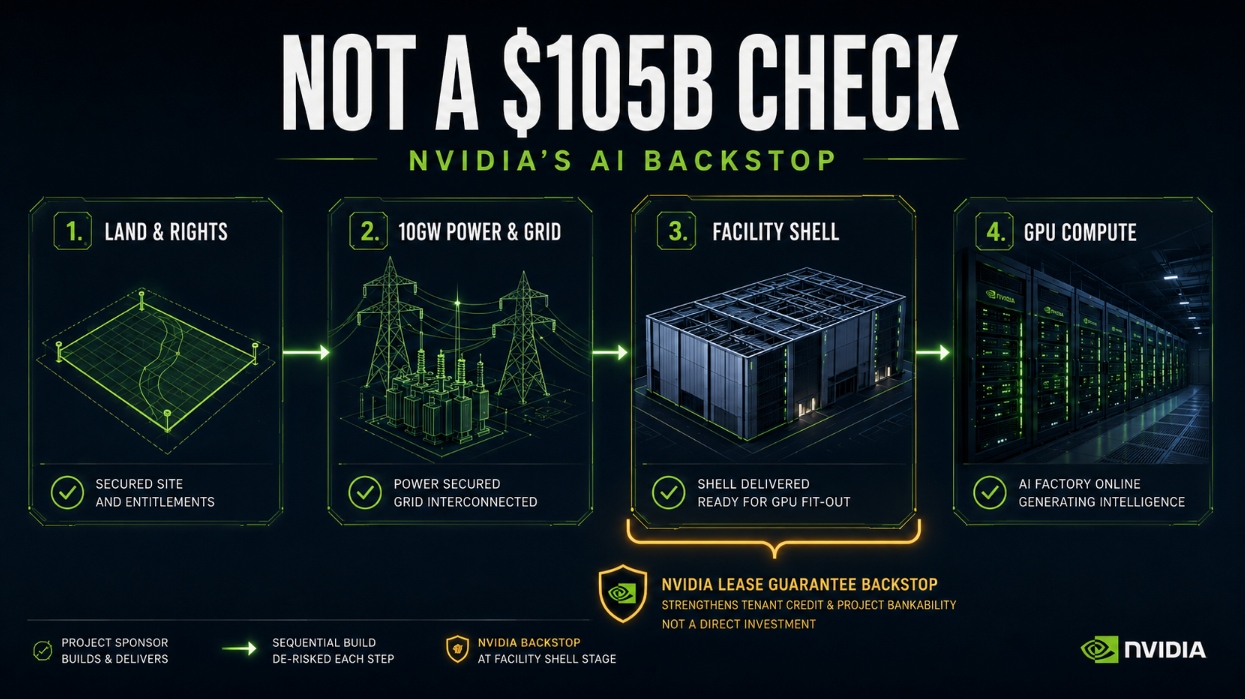
By backstopping long-term leases, Nvidia secures the physical real estate, grid allocations, and structural shells required for future deployments. In partnership with SB Energy and regional utilities, the framework supports an initial 8 gigawatt (GW) footprint—structured across a 4.25 GW base phase and a 3.8 GW expansion—backed by 10 GW in dedicated generation plans and an estimated $4.2 billion in electrical grid upgrades. Nvidia is not purchasing land; it is ensuring that electrified land exists when its future silicon architectures roll off the foundry lines.
Inside the Terms: 8 GW, 20-Year Leases, and Risk Allocation
The multi-party framework redistributes technical, operational, and financial risk across specialized balance sheets. Infrastructure developers own the physical assets, institutional debt funds provide construction capital, OpenAI assumes primary lease obligations, and Nvidia absorbs downside residual-value risk in exchange for commercial certainty.
| Infrastructure Layer | Primary Stakeholders | Operational Role | Nvidia Financial Exposure |
| Land & Power Grid | SB Energy, Utilities, Grid Operators | Securing 10 GW power rights, $4.2B grid buildout | Indirect; dependent on infrastructure execution |
| Facility Shell & Core | Infrastructure Developers, Lenders | Building physical data center structures | Up to $105B contingent residual-value backstop |
| Tenant Operations | OpenAI | Deploying models, managing operational cash flow | Primary leaseholder; default triggers guarantee |
| Silicon & Compute | Nvidia | Supplying GPU architectures and networking | $1.5B direct equity; primary hardware beneficiary |
By bifurcating the asset lifecycle, the consortium separates the 20-year structural life of a data center building from the 3-to-5-year depreciation cycle of AI accelerators. Nvidia ensures that the high-cost, long-lead physical envelope is constructed without taking direct operational custody of concrete and high-voltage transformers.
From Hardware Vendor to AI Credit Backstop
This transaction marks a structural evolution in semiconductor business models. Historically, fabless chip designers maintained clean balance sheets, leaving infrastructure development and financing entirely to enterprise customers and cloud service providers.
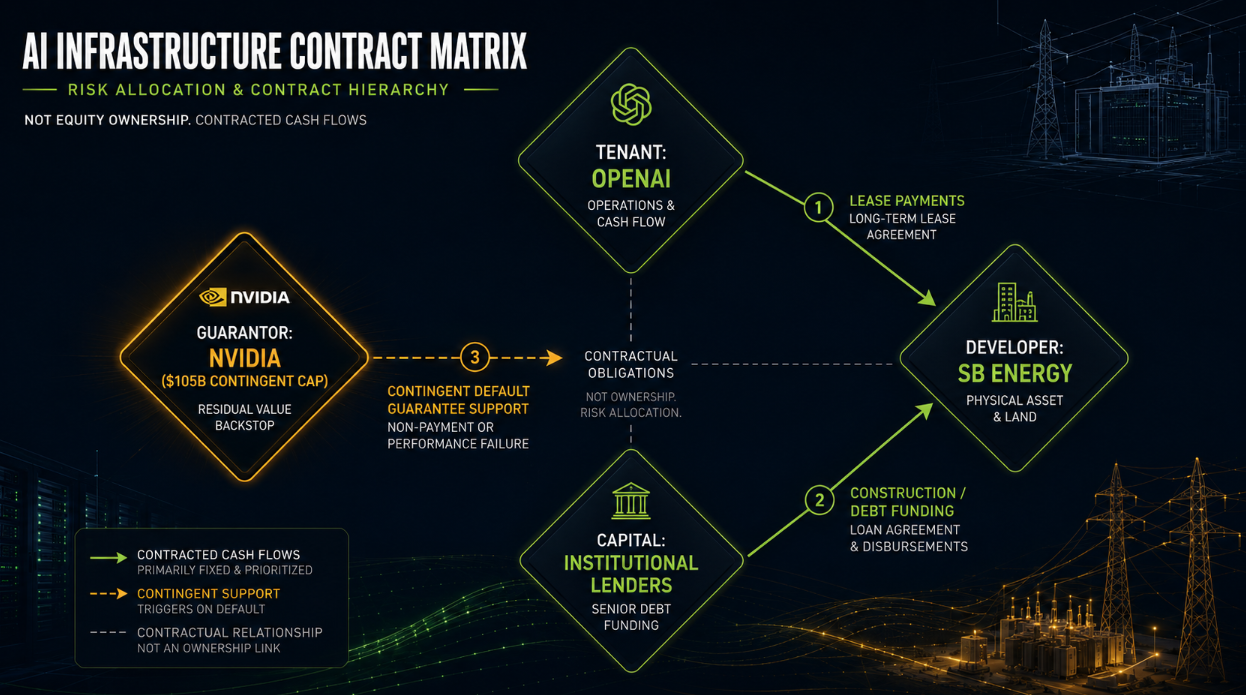
By acting as a credit enhancer, Nvidia adopts a strategy reminiscent of commercial aircraft manufacturers or telecommunications equipment vendors during major infrastructure buildouts. The objective is commercial lock-in: ensuring that OpenAI’s long-term compute expansion remains anchored to Nvidia’s software ecosystem and hardware roadmaps rather than custom ASICs or alternative merchant accelerators.
Structural Risks: Concentration, Obsolescence, and Execution
While the strategic rationale is clear, the arrangement introduces three structural risks that equity analysts must factor into long-term risk assessments:
- Single-Tenant Credit Concentration: Nvidia’s contingent liability is tied directly to OpenAI. If generative AI inference margins compress or market share shifts, OpenAI’s ability to service 20-year lease commitments without external subsidies could deteriorate.
- Hardware Obsolescence vs. Facility Duration: A 20-year data center lease spans four to five discrete compute architecture cycles. If cooling, liquid distribution, or power density requirements change fundamentally, the residual market value of guaranteed shells could decline below underwritten levels.
- MOU Execution vs. Realized Capital: The broader narrative surrounding a $500 billion AI financing platform remains in a non-binding Memorandum of Understanding (MOU) status. Investors must not treat aspirational headline targets as fully closed institutional liquidity.
The Investor Decision Framework
To determine whether Nvidia’s guarantee model is value-accretive, investors should evaluate the transaction through three observable milestones:
- 8-K Default and Trigger Covenants: Monitor subsequent SEC filings for explicit cure periods, debt-service coverage ratios, and specific scenarios under which guarantee payments can be demanded by lenders.
- Interconnection Queue Approvals: Track regulatory filings with regional transmission organizations (such as PJM) to confirm that the planned 10 GW generation and $4.2 billion grid upgrades receive final interconnection authorization.
- MOU to Definitive Agreement Conversion: Watch for the transition of the $500 billion financing consortium from non-binding frameworks into legally binding, syndicated credit facilities.
Nvidia’s $105 billion guarantee is neither an unmitigated capital giveaway nor a risk-free marketing maneuver. It is a calculated use of balance-sheet strength to clear the physical power and infrastructure bottlenecks threatening long-term semiconductor growth.
FAQ
Did Nvidia invest $105 billion in cash into OpenAI?
No. The $105 billion figure is the cumulative ceiling of a contingent residual-value guarantee on 20-year data center leases, not an upfront cash investment. Nvidia’s direct initial equity commitment is limited to $1.5 billion.
What is a residual-value guarantee in AI data center financing?
A residual-value guarantee is a contractual backstop where a guarantor (Nvidia) agrees to absorb losses or cover remaining lease value if the primary tenant (OpenAI) defaults or terminates the facility lease prematurely, protecting the lenders who financed construction.
Is the $500 billion AI infrastructure financing platform fully funded?
No. The broader $500 billion financing initiative is currently structured under a non-binding Memorandum of Understanding (MOU). It outlines future financing intent and development roadmaps but does not represent finalized, syndicated institutional capital.