Zillow paid Redfin $100 million for an exclusive multifamily rentals partnership. Now an FTC settlement is bringing Redfin back as an independent competitor just as Zillow’s Rentals business is growing rapidly.
Zillow paid Redfin $100 million in 2025. A year later, an FTC settlement is putting Redfin back into the same multifamily advertising market — just as Zillow’s Rentals business is growing 31% year over year. That is what makes this more than an antitrust story.
The $100 million explains how Zillow gained Redfin’s rental distribution while Redfin stepped away from independently competing for much of the same multifamily advertising business. The settlement now separates those two benefits: Zillow can keep much of the distribution, but Redfin gets to compete again. For investors, that creates a much cleaner test of Zillow’s Rentals business.
The question is no longer simply whether Zillow can grow Rentals. It is how much of its recent multifamily growth can survive when property managers once again have another independent national platform asking for their advertising dollars.

Table of Contents
Why Zillow Paid Redfin $100 Million
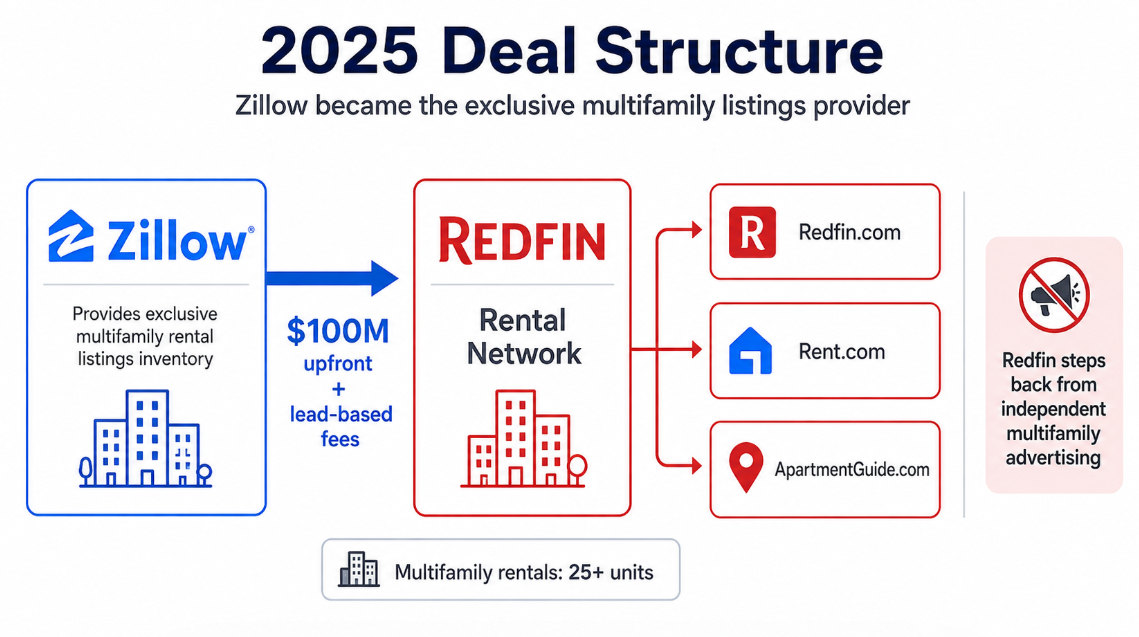
The deal dates back to February 2025. Zillow and Redfin created a partnership covering multifamily rental properties, generally buildings with 25 or more units. Zillow became the exclusive provider of those listings across Redfin.com, Rent.com and ApartmentGuide.com.
Redfin, meanwhile, stopped independently selling many of the multifamily advertising products that had previously put it in direct competition with Zillow. Zillow paid Redfin an upfront $100 million and agreed to additional payments tied to renter leads generated through Redfin’s network. The economic value of the agreement was therefore broader than simply putting Zillow listings on more websites.
Zillow gained distribution, but it also gained access to property-management relationships that had previously belonged to Redfin while Redfin stepped away from independently competing for much of that advertising business. That second part became central to the FTC’s case. Regulators argued that Zillow had effectively paid an existing competitor to withdraw from the multifamily internet-listing advertising market and transition customers toward Zillow.
Zillow disputed that characterization and argued that the partnership expanded rental inventory across both networks and gave renters access to more listings. Those two claims should remain separate. The government’s case was primarily about competition between advertising platforms, while Zillow’s defense emphasized distribution and consumer access to listings.
The FTC Is Bringing Competition Back, Not Ending the Partnership
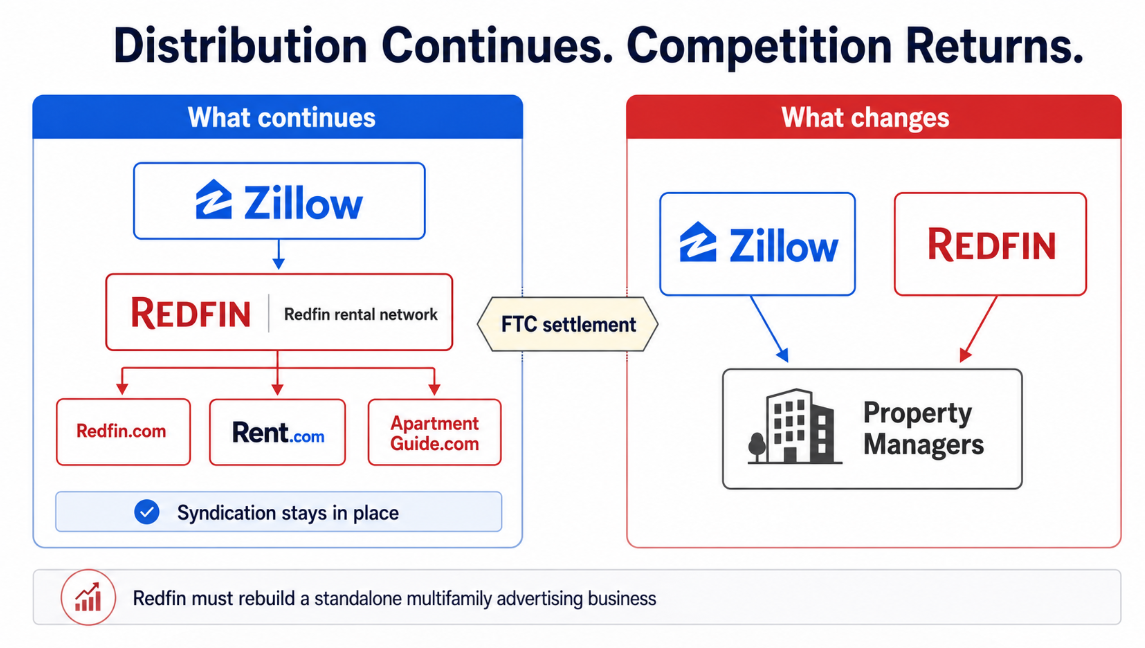
The August 2026 settlement does not simply tear up the Zillow-Redfin relationship. Zillow listings can continue to appear across Redfin’s rental network, and the companies can preserve the syndication arrangement that distributes listings across Zillow, Redfin, Rent.com and ApartmentGuide.com. What changes is Redfin’s ability to compete independently.
Under the settlement structure, Redfin must rebuild its own multifamily internet-listing advertising business. That includes the infrastructure required to operate as a genuine standalone competitor, such as sales operations, customer support, billing and customer-facing systems. Redfin is required to reenter the business within six months after the court enters the order.
That timing should not be shortened to “six months from the FTC announcement,” because the relevant clock begins with court entry of the order. Zillow has also said it expects both companies to offer standalone multifamily advertising products in 2027 while their syndication relationship continues. The result leaves Zillow with an unusual combination: it keeps the distribution benefits but loses the assurance that Redfin will stay out of the fight for the advertiser.
| 2025 Arrangement | After the FTC Settlement |
|---|---|
| Zillow becomes exclusive multifamily listing provider across Redfin rental sites | Zillow syndication can continue |
| Redfin winds down much of its independent multifamily advertising business | Redfin must rebuild a standalone advertising business |
| Zillow pays $100M upfront plus lead-related payments | Existing commercial relationship remains |
| Redfin customers can transition toward Zillow | Redfin can again pursue property managers directly |
| Competition between the two platforms is restricted | Independent competition returns |
The settlement therefore separates two things that had been bundled together: distribution and competition. Zillow can continue benefiting from having its inventory distributed through Redfin-controlled sites, but Redfin can once again pursue property managers on its own. That is the distinction investors should remember.
The 14.5% Estimate Points to the Real Question: Pricing Power
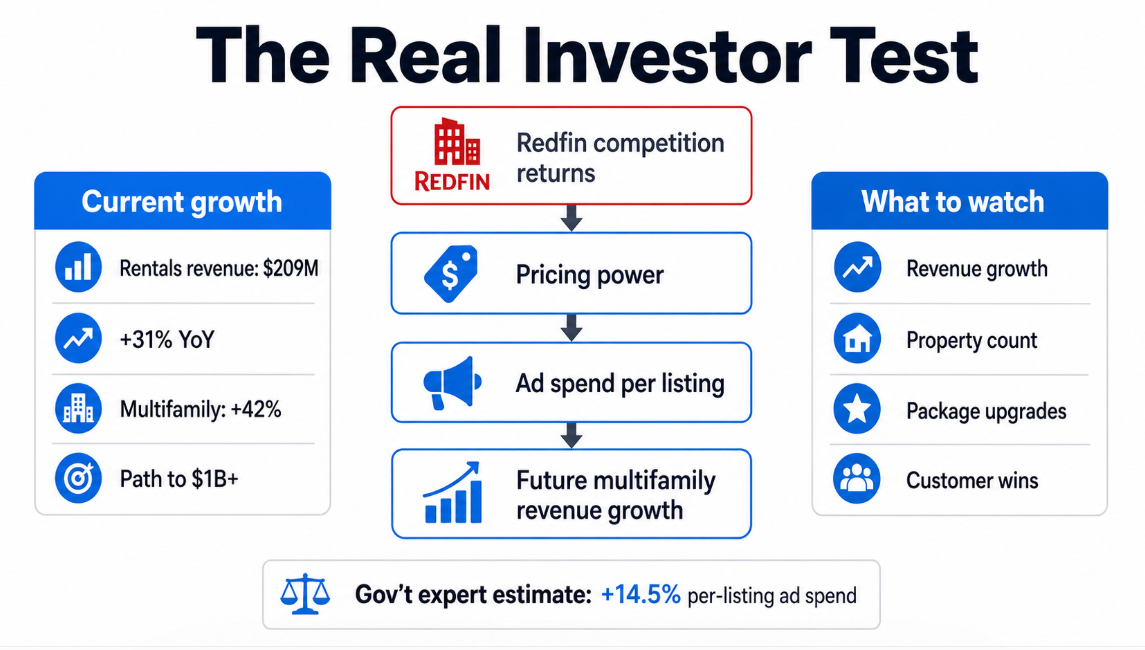
One number in the government’s case deserves careful treatment. An expert for the FTC and plaintiff states estimated that Zillow customers paid an average of 14.5% more per listing after Redfin stopped competing independently. This was not a 14.5% increase in apartment rents; it referred to what property managers were paying for rental advertising listings.
It was also not a final court finding. The figure came from the government side’s expert analysis, and the litigation was resolved without a trial producing a merits judgment on that estimate. Those qualifications matter, but the number still points directly at the economic question behind the case: did weaker competition give Zillow more pricing power over multifamily advertisers?
If Zillow’s advertising product generates clearly superior returns for property managers, customers may willingly pay more even with Redfin back in the market. If recent monetization partly benefited from having one fewer meaningful alternative, competition should eventually show up through lower price increases, more discounts, slower package upgrades, higher churn or weaker revenue growth relative to property growth. This is where the FTC settlement stops being primarily a legal story and becomes a business-model test.
Zillow Rentals Is Growing Fast Enough for This Test to Matter
Zillow reported $209 million in Rentals revenue in Q2 2026, up 31% year over year. Multifamily revenue grew even faster at 42%, while the platform reached approximately 79,000 multifamily properties, an all-time high. Zillow also continues to describe a path toward more than $1 billion in annual Rentals revenue.
Those numbers change the importance of the Redfin settlement. If Rentals were a small side business, renewed competition would be interesting but not especially important. Instead, Rentals is becoming one of Zillow’s major growth engines.
Management has attributed that growth to a combination of more properties on the platform and deeper monetization from property managers, including customers buying higher-value advertising packages. That means simple property-count growth will not tell the whole story once Redfin returns. The important relationship is competition → pricing power → multifamily revenue growth.
Redfin does not need to take every Zillow customer for competition to matter. It only needs to create a credible alternative that property managers can use when deciding where to spend their advertising budgets. That alone can change their bargaining position with Zillow.
Zillow’s ‘Pricing Power’ Is About to Get a Better Test
There is a weak version of the bearish argument: Redfin comes back, therefore Zillow Rentals growth falls. That conclusion goes too far. Zillow still has a large rental audience, broad inventory, established relationships with property managers and a growing suite of tools around the rental transaction.
Redfin also has to rebuild a business it previously wound down. A regulatory order allowing competition to return does not instantly recreate a fully effective competitor. The more useful question is what happens to Zillow’s monetization after Redfin becomes credible enough for property managers to use it as leverage.
Suppose Zillow keeps adding multifamily properties and its multifamily revenue continues growing much faster than property count. That would strengthen the case that customers are paying more because Zillow delivers enough value to justify it. If property count keeps rising but multifamily revenue growth slows sharply after Redfin returns, the competitive effect may be showing up through weaker pricing or lower advertising spend per property rather than lost inventory.
That distinction matters because a marketplace can keep growing its supply while losing some of its pricing power. Looking only at the number of properties on Zillow could therefore give investors an incomplete picture. Revenue growth relative to property growth should become more informative once Redfin is actively selling again.
The Settlement Creates a Rarely Visible Competitive Test
Antitrust cases often end with rules that are difficult for outside investors to measure. This one may be different because the settlement requires Redfin to rebuild an independent business and includes provisions intended to make it easier for certain property managers to reconsider existing Zillow relationships once Redfin returns. That creates several observable signals.
| What to Watch | Stronger Zillow Case | Warning Sign |
|---|---|---|
| Multifamily revenue growth | Remains strong after Redfin relaunch | Material deceleration |
| Multifamily property count | Continues increasing | Growth stalls or reverses |
| Revenue vs. property growth | Revenue continues outpacing property growth | Monetization gap narrows sharply |
| Advertising-package upgrades | Customers continue moving into higher-value packages | More discounting or weaker upgrade commentary |
| Redfin customer wins | Limited traction | Rapid recovery of major property managers |
| Contract renegotiations | Little visible pricing pressure | More concessions or customer exits |
The key is not simply whether Redfin signs customers. Some customer movement would be unsurprising if Redfin rebuilds a functioning national sales organization. The more important question is whether that movement changes Zillow’s economics.
Zillow Could Still Reach $1 Billion — but the Evidence Would Mean More
There is a potentially favorable outcome for Zillow hidden inside the settlement. The company keeps the syndication network, meaning its listings can continue appearing across Redfin-controlled rental properties, while Redfin begins independently competing again. If Zillow can keep multifamily revenue growing rapidly under those conditions, the quality of that growth becomes easier to defend.
It would suggest Zillow does not need a weakened Redfin to keep increasing its share of property-manager advertising budgets. That would be more convincing than growth achieved while one previous competitor was contractually restricted. The opposite result would also tell investors something useful.
If Zillow’s property inventory remains strong but monetization slows after Redfin returns, competition may have been more important to the economics of the business than the headline growth rates suggested. In other words, either outcome gives investors better information. The settlement turns a regulatory dispute into a test of the economics behind Zillow’s growth.
What I Would Watch Next
The first milestone is Redfin’s actual return to independent multifamily advertising — not merely an announcement or the existence of the settlement. What matters is a functioning business with salespeople, customers, billing infrastructure and property managers actively choosing between Redfin and Zillow. After that, Zillow’s quarterly Rentals numbers become much more informative.
1. Multifamily Revenue Growth
The first question is whether multifamily revenue remains near the elevated growth rates Zillow has recently reported. A meaningful deceleration after Redfin becomes operational would not prove pricing pressure by itself, but it would make competition a much more important explanation to test.
2. Property Growth Versus Revenue Growth
Property count and revenue should be watched together rather than separately. If properties keep growing while revenue growth slows much faster, pricing or wallet share may be weakening. If revenue continues materially outpacing property growth, Zillow’s monetization story would look more resilient.
3. Package Upgrades and Customer Spending
Management commentary around advertising-package upgrades may become particularly useful. If property managers continue voluntarily buying more expensive products while Redfin is actively competing, that would materially strengthen the Rentals thesis. Increasing monetization under renewed competition would be more persuasive than increasing monetization while Redfin was constrained.
That is why the FTC settlement does not automatically break Zillow’s path toward $1 billion-plus Rentals revenue. It changes what would count as convincing evidence. The $100 million payment got the attention, but the more important number will be what Zillow’s multifamily growth looks like after Redfin starts selling again.
FAQ
Why did Zillow pay Redfin $100 million?
The payment was part of a multifamily rentals partnership under which Zillow became the exclusive provider of large-property rental listings across Redfin’s rental network. The arrangement also shifted many property-manager relationships toward Zillow while Redfin wound down much of its independent multifamily advertising operation.
Did the FTC cancel the Zillow-Redfin rental partnership?
No. The settlement allows the listing-syndication relationship to continue. The major change is that Redfin must return as an independent competitor in multifamily rental advertising.
Did Zillow raise rents by 14.5%?
No. The 14.5% figure was a government-side expert estimate relating to per-listing advertising spending by Zillow customers, not apartment rents. It was also not established as a final court finding.
When Will Redfin Compete With Zillow Again?
The settlement requires Redfin to reenter the independent multifamily advertising business within six months after the court enters the order. The companies have also indicated that standalone advertising products are expected in 2027.
What Matters Most for Zillow Investors Now?
Watch whether multifamily revenue continues growing faster than property count after Redfin becomes a credible independent alternative. That would provide a clearer test of Zillow’s pricing power and the durability of its Rentals growth.
Nvidia Sees 70% Growth — Why Is Memory Still a Bottleneck?
Nvidia Sees 70% Growth — Why Is Memory Still a Bottleneck?
더보기Nvidia expects about 70% revenue growth in fiscal 2028, yet it still describes supply as constrained. Here is how memory availability and rising memory costs can limit shipments and pressure margins at the same time. Nvidia expects revenue to grow
global.kkomccom.com
Did Boeing Really Win a $131 Billion F-15 Contract? What the Number Actually Means
Did Boeing Really Win a $131 Billion F-15 Contract? What the Number Actually Means
더보기Boeing’s $131.23 billion F-15 Eagle Crest award is real, but the headline number is an IDIQ ceiling—not guaranteed revenue. Here’s what the $343,740 obligation, future orders and Boeing backlog actually tell investors.Boeing really was award
global.kkomccom.com
'Explainers' 카테고리의 다른 글
| The USMCA Exemption Myth: Why Section 338 Hits Canadian Goods with 50% Tariffs (0) | 2026.08.23 |
|---|