Holding a USMCA Certificate of Origin will not block America's 50% Section 338 tariff. Learn how duty stacking overrides preferential trade rules and why 554 Canadian tariff lines are exposed.
A USMCA Certificate of Origin eliminates normal baseline customs duties, but it provides zero legal immunity against statutory retaliation. The U.S. administration did not scrap the USMCA; it simply bypassed it by invoking Section 338 of the Tariff Act of 1930, a dormant statutory weapon that allows punitive duties regardless of trade pact origin.
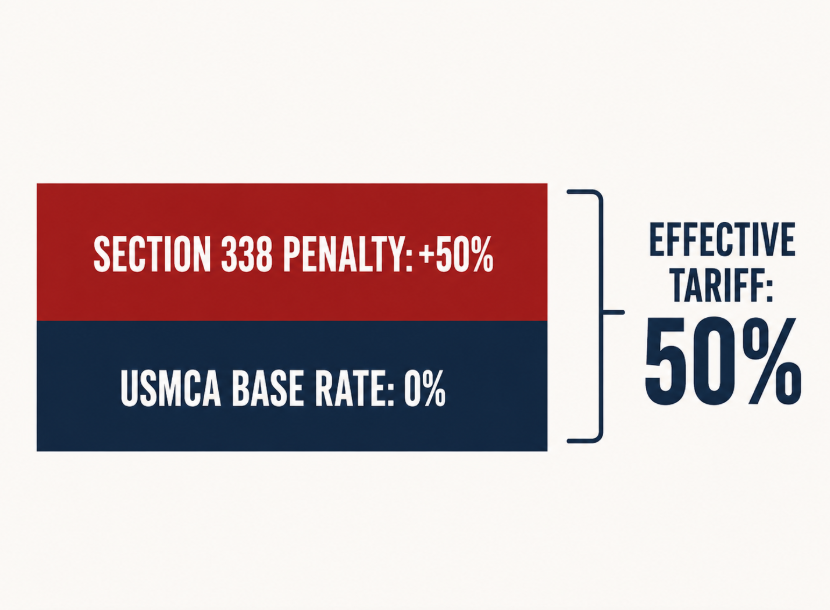
Importers face a simple mathematical reality called duty stacking: a 0% preferential base rate plus a 50% Section 338 penalty equals an effective 50% cash duty at the border.
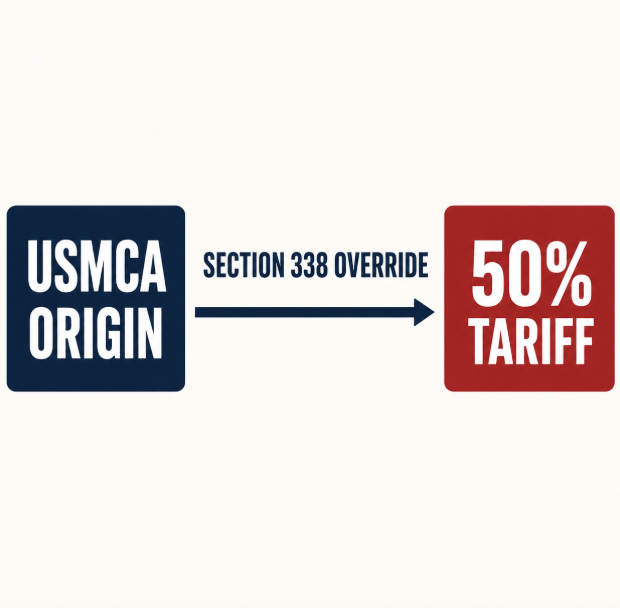
Table of Contents
For decades, supply chain executives and corporate treasurers treated a USMCA Certificate of Origin as an ironclad guarantee of duty-free access to the United States.
That assumption is dead.
Under three presidential proclamations targeting alleged Canadian trade discrimination, the United States has imposed a sweeping 50% ad valorem tariff on covered Canadian products. When cross-border manufacturers reached for their standard defense—filing USMCA preferential origin paperwork—customs authorities pushed it aside. U.S. Customs and Border Protection (CBP) directives make the legal reality unambiguous: the 50% tariff applies to every targeted line, regardless of whether a good was 100% made in Canada under treaty rules.
The confusion stems from a fundamental misunderstanding of U.S. trade law: free trade agreements control normal customs rates, but they do not constrain executive retaliation power.
The Legal Hierarchy: Preferential Trade vs. Retaliatory Overrides
The United States-Mexico-Canada Agreement (USMCA) eliminates baseline Most-Favored-Nation (MFN) tariffs (known as Column 1 rates) under Chapter 2 and Chapter 4. If an automotive part, machine, or food product meets the required Regional Value Content (RVC), its statutory base duty drops to 0.0%.
However, trade agreements do not repeal domestic trade defense statutes.
When the White House invoked Section 338 of the Tariff Act of 1930 (19 U.S.C. § 1338), it deployed a separate legal track:
- Baseline Customs Tariff: Governed by the USMCA Implementation Act $\rightarrow$ Reduced to **0.0%**.
- Statutory Retaliatory Tariff: Mandated by Section 338 Proclamation $\rightarrow$ Assessed at **+50.0%**.
- Effective Border Duty: 0.0% + 50.0% = **50.0% ad valorem**.
This mechanism is known as duty stacking. The administration did not revoke the USMCA, violate its origin formulas, or withdraw from the treaty. Instead, it instructed customs officials to layer a retaliatory penalty directly over the baseline rate.
Because presidential proclamations carry the force of federal statute, CBP cannot grant administrative waivers based on USMCA certificates unless the text of the proclamation explicitly provides an exemption. These proclamations did the exact opposite: they explicitly ordered the duties applied regardless of USMCA origin.
Comparing USMCA Preferential Treatment vs. Section 338 Retaliatory Duties
| Legal & Operational Dimension | Standard USMCA Entry | Section 338 Retaliatory Entry |
| Statutory Authority | USMCA Implementation Act (19 U.S.C. Ch. 29) | Tariff Act of 1930 (19 U.S.C. § 1338) |
| Core Objective | Regional supply chain integration | Unilateral punishment for trade discrimination |
| Origin Paperwork Defense | Valid Certificate of Origin = 0% Duty | Valid Certificate of Origin = Ignored |
| Duty Calculation | Base MFN rate replaced by 0% | +50% stacked on top of effective base rate |
| Procedural Hurdle | Subject to bi-national dispute panels | Unilateral presidential finding; no prior ITC review |
| Target Universe | Broad, treaty-wide eligible tariff lines | 554 specific 8-digit HTSUS lines in Annex II |
What Makes Section 338 Such a Brutal Weapon?
Most modern trade battles rely on Section 301 (intellectual property and unfair trade) or Section 232 (national security). Both require extensive administrative groundwork: the Department of Commerce or the USTR must publish public notices, conduct formal investigations, and evaluate economic fallout.
Section 338 requires none of that.
Drafted nearly a century ago during the Smoot-Hawley era, Section 338 is an executive bludgeon designed for rapid retaliation:
1. Pure Executive Discretion:
The President needs only to determine that a foreign country discriminates against American commerce "in fact or in law." No agency study, no public comment period, and no economic impact statement is required.
2. Statutory 50% Ceiling:
The law authorizes a flat duty of up to 50%. If the foreign nation does not yield, the statute permits the President to escalate to a total commercial embargo on all imports from that country.
3. Zero Treaty Deference:
Section 338 operates completely independent of bilateral dispute resolution mechanisms. Filing a USMCA Chapter 31 dispute panel does not stay the collection of duties at the border.
The administration anchored its legal justification on longstanding grievances: Canadian dairy tariff-rate quotas (TRQs), provincial retail barriers against U.S. alcohol, and vehicle regulatory barriers. Whether those claims survive judicial scrutiny is irrelevant for near-term cash flow—tariffs must be deposited in cash upon customs entry today.
The Annex II Trap: Why the "Auto" Proclamation Hits Far Beyond Cars
Corporate risk managers who glance only at proclamation titles are walking into an expensive trap.
While public headlines talk about cars, dairy, and liquor, the legal liability is determined entirely by Annex II across Proclamations 11046, 11047, and 11048.
Together, these annexes target 554 eight-digit HTSUS tariff lines, representing roughly $20 billion in annual cross-border trade.
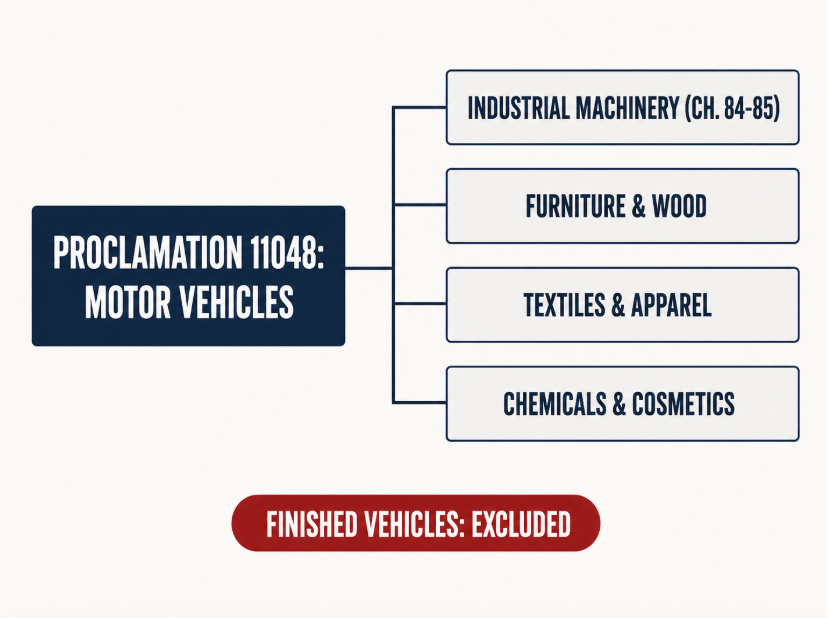
The biggest trap lies in Proclamation 11048 (labeled Motor Vehicles):
- The Reality of Annex II: Despite its title, Proclamation 11048 contains zero finished passenger vehicles from HTS Chapter 87.
- The Actual Targets: It sweeps up 439 eight-digit tariff lines spanning specialized industrial machinery (Chapters 84 & 85), structural wood, cement, metal fabrications, furniture, textiles, cosmetics, and precision equipment.
- The Other Proclamations: Proclamation 11046 covers 63 beverage and retail lines, while Proclamation 11047 covers 52 processed dairy components (milk protein concentrates, industrial whey, casein).
Breakdown of the Three Section 338 Proclamations and Product Coverage
| Proclamation & Stated Target | 8-Digit HTSUS Lines | Stated Regulatory Grievance | Actual Products Exposed in Annex II | Critical Carve-Outs |
| Proclamation 11048 (Motor Vehicles) | 439 lines | Canadian auto standards & market access | Heavy machinery, electronics, furniture, textiles, chemicals | Finished cars, goods under Section 232 |
| Proclamation 11046 (Alcoholic Beverages) | 63 lines | Provincial liquor board markups & access | Distilled spirits, craft beer, wine, select sports items | Non-alcoholic beverages |
| Proclamation 11047 (Dairy Products) | 52 lines | Dairy TRQ allocation rules | Industrial whey, cheese varieties, milk powders | Retail fluid milk under existing quotas |
| Strategic Exemptions | Excluded | National security & core energy interdependence | Unaffected: Crude oil, natural gas, electricity, potash, critical minerals | Items already paying Section 232 steel/aluminum duties |
The Unvarnished Truth for Supply Chain Investors
This enforcement action redraws the rules of North American manufacturing. Investors and corporate boards must draw a hard line between what the USMCA still protects and what has evaporated.
What USMCA Still Delivers
- Protection for Non-Covered Lines: The vast majority of U.S.-Canada merchandise trade (roughly 95%) remains outside the 554 Annex II codes and continues to clear customs at 0% under standard USMCA rules.
- Core Energy Insulation: Crude oil, refined products, natural gas, electricity, uranium, potash, and critical minerals remain explicitly carved out from Section 338 duties.
- Third-Party Tariff Shield: Valid USMCA certificates continue to protect against normal third-party Column 1 tariffs that apply to non-FTA nations.
What USMCA No Longer Guarantees
- Absolute Regulatory Immunity: A trade agreement is not a sovereign ceasefire. Holding perfect origin records offers zero protection against executive statutory retaliation.
- Nearshoring Cost Assumptions: Building a plant in Ontario or Quebec as a tariff-free proxy for the U.S. market now carries structural headline risk. If an 8-digit tariff line lands on an executive retaliatory list, regional origin calculations are entirely bypassed.
- Transshipment Loopholes: Moving Canadian goods through Mexican logistical hubs or warehousing nodes does not erase non-preferential Canadian origin. Unless a product undergoes substantial manufacturing transformation in a third country, the 50% Section 338 liability follows the freight.
Actionable Decision Rules: What to Audit Immediately
If your business imports from Canada or holds equity in Canadian industrial assets, stop debating trade policy ethics and execute four immediate audits:
1. Run a Rigid 8-Digit HTS Code Screen
Sector-level generalizations are useless. Compare your exact commercial invoice codes against the 554 tariff lines published in Annex II across the three proclamations. A single sub-component code can trigger the full 50% cash duty.
2. Audit Commercial Incoterms
heck who acts as the Importer of Record. Under **DDP (Delivered Duty Paid)** terms, the Canadian exporter is legally responsible for paying the 50% duty directly to CBP. Under **FOB or EXW**, the U.S. buyer gets hit with the cash demand upon entry.
3. Verify Section 232 Exclusions
Check whether your goods are already subject to Section 232 steel, aluminum, or auto tariffs. The Section 338 proclamations explicitly bar double-penalties; if an item pays Section 232 duties, Section 338 does not apply.
4. Prepare Cash-Flow Escrow
Lawsuits filed in the U.S. Court of International Trade (CIT) challenging the President's use of Section 338 will take months or years. Until a federal judge issues an active nationwide preliminary injunction, CBP demands immediate cash duty deposits at customs clearance.
USMCA compliance is still necessary, but it is no longer sufficient. If your product code is on the Annex II list, the treaty will not save you from the tariff.
FAQ
Does a valid USMCA Certificate of Origin waive the 50% Section 338 tariff?
No. The presidential proclamations explicitly mandate that the 50% ad valorem duty applies to all covered Canadian products listed in Annex II, completely overriding USMCA preferential origin certificates.
Are all Canadian exports to the United States subject to the 50% tariff?
No. The tariffs are strictly confined to the 554 eight-digit HTSUS tariff lines listed in Annex II across the three proclamations. Essential strategic commodities—including crude oil, natural gas, electricity, potash, critical minerals, and products already paying Section 232 duties—are entirely exempt.
Why does the "Motor Vehicle" proclamation hit furniture and industrial machinery instead of cars?
Under Section 338, the named grievance reflects the foreign policy dispute (vehicle rules), but the President holds broad statutory authority to select any tariff lines for retaliation. As a result, Annex II of Proclamation 11048 targets 439 broad industrial, textile, and manufacturing lines rather than finished passenger cars.
Can an importer avoid the 50% tariff by routing Canadian goods through Mexico?
No. Section 338 duties attach based on non-preferential country of origin (where the product was manufactured or substantially transformed), not the shipping route. Transshipping goods through Mexico without genuine industrial transformation will not remove Section 338 customs liability.
Walmart Beat Earnings. Why Did WMT Still Drop 9%?
Walmart Beat Earnings. Why Did WMT Still Drop 9%?
더보기Walmart beat Q2 FY27 earnings and raised its full-year outlook, yet WMT fell more than 9%. The reason was simple: investors cared more about weaker U.S. sales momentum and soft Q3 guidance than the quarter Walmart had already finished. Walmart bea
global.kkomccom.com
Why Alphabet Issued Its First Australian Dollar Bond: Inside Google's AI Financing Playbook
Why Alphabet Issued Its First Australian Dollar Bond: Inside Google's AI Financing Playbook
더보기Alphabet issued an inaugural A$5.5B Kangaroo bond to diversify funding for its $200B AI infrastructure buildout. Here is what the deal proves for tech balance sheets. Alphabet's inaugural A$5.5 billion ($3.9 billion) Australian dollar bond issuanc
global.kkomccom.com
'Explainers' 카테고리의 다른 글
| Zillow Paid Redfin $100 Million. Now Redfin Is Coming Back as a Rentals Competitor. (0) | 2026.08.28 |
|---|