More than 700 gigawatts of electricity requests from very large power users, mostly data centers, have accumulated across parts of the U.S. Midwest, Mid-Atlantic and South.
That is a huge number. It is also easy to misread.
700 GW of power requests does not mean 700 GW of data center load will actually appear on the grid.
Some requests represent financed projects moving toward construction. Others are early-stage sites, competing location options, duplicate requests or projects that may never secure enough capital, customers or infrastructure to get built.
That gap between the headline queue and credible future electricity use is increasingly described as data center “ghost demand.”
The problem is not that every unbuilt project is fake. It is that an initial power request and an operating data center are two very different things.
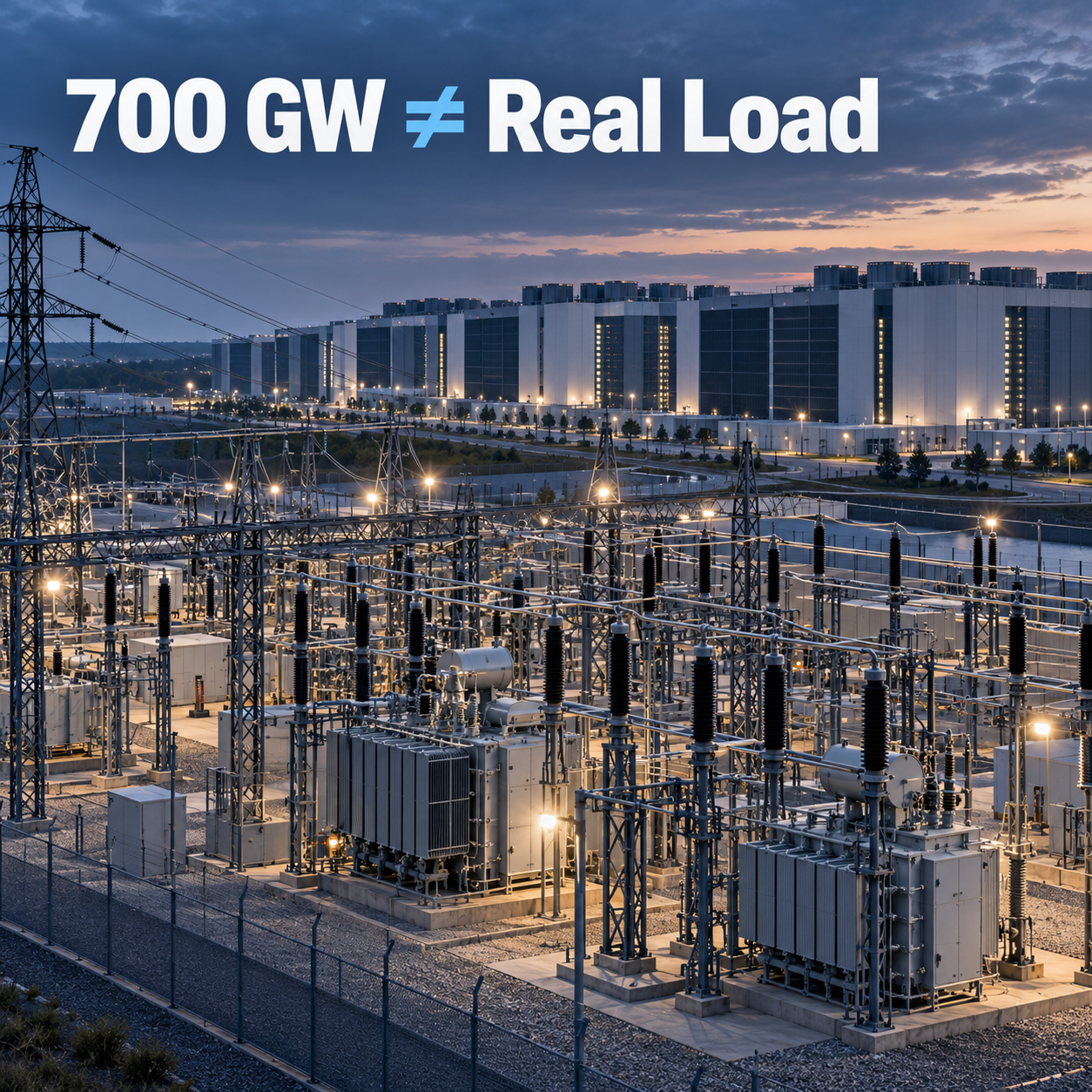
Table of Contents
What data center “ghost demand” actually means
Ghost demand appears before electricity is consumed.
A developer planning an AI campus may ask whether a utility can provide 500 MW, 1 GW or more at a particular site. That request gives the developer information about whether the location could work, while giving the utility an early signal of possible future load.
Neither side can simply wait until construction is finished.
Large substations, transformers, transmission upgrades and new generation can take years to plan and build. Developers therefore have a legitimate reason to ask for power well before a campus is ready to switch on.
The problem begins when those early requests are added together as though they all represent committed future demand.
A company may be comparing several locations at once. A developer may submit a request before financing is finished. Another project may have land but no final customer. Some proposals will change size, move or disappear.
So the useful distinction is not between a project that is “real” and one that is “fake.”
It is between requested load, financially committed load and energized load.
| Typical stage | What it tells us | What it does not prove |
| Initial power request | A developer wants to know whether capacity may be available | The project will be built |
| Grid study | The project is being tested against the power system | Financing or construction is certain |
| Deposit or collateral | The developer has more money at risk | The site will reach full load |
| Binding service contract | The commitment is materially stronger | Electricity is already being consumed |
| Energization | The facility has begun taking power | Every announced expansion will follow |
The labels differ by utility and grid region, but the principle is the same:
A megawatt becomes more credible as the developer accepts more technical, legal and financial commitments.
Ohio shows what happens when requests meet real commitments
AEP Ohio is a useful example because it has put numbers around this gap.
Before its new Data Center Tariff was approved, AEP Ohio said data centers and developers had submitted requests totaling about 30,000 MW.
That created a clear risk. If a utility builds infrastructure around every preliminary request and some projects disappear, other customers can be left exposed to the cost of equipment that is no longer needed.
The new tariff introduced stronger legal and financial commitments, including collateral and obligations intended to encourage more realistic load estimates.
As of February 12, 2026, AEP Ohio said data centers and developers had signed 5,642 MW of binding contracts under the new tariff.
Another 12,219 MW had already been contracted before the tariff took effect, bringing total contracted data center projects to 17,861 MW, scheduled to come online progressively through 2035.
Those numbers should not be read as “30 GW fell directly to 5.6 GW.” They describe different groups and different stages.
A preliminary request tells the utility that someone is interested in getting power.
A binding contract tells it that the customer has moved much further toward accepting the legal and financial obligations attached to that power.
That is a much stronger planning signal.
Texas has the same problem at a much larger scale
Texas shows what happens when the pipeline expands faster than the process used to evaluate it.
Reuters reported in September 2026 that requests from data centers and other large energy users seeking to connect to the Texas grid had risen from roughly 48 GW in 2023 to more than 474 GW.
That does not mean 474 GW of new Texas load will definitely materialize.
ERCOT has been changing the way it handles large-load interconnection requests. Its Batch Zero framework applies to eligible large loads of 75 MW or more and evaluates qualifying projects on a system-wide basis rather than treating the old queue as a simple list of independent projects.
The Public Utility Commission of Texas approved the framework in June 2026, with implementation beginning in July.
Texas then added another filter.
On August 3, Governor Greg Abbott directed ERCOT and state regulators to verify data center projects before allowing them to advance through the interconnection process. By September, ERCOT had begun issuing verification requests for information to a majority of large-load entities conditionally included in Batch Zero.
The question is no longer just:
How much new electricity can the grid supply?
It is also:
Which proposed loads are mature enough to plan the grid around?
Why developers enter the queue before they are ready to build
It would be easy to treat ghost demand as nothing more than developers exaggerating electricity requirements.
That is too simple.
Power availability affects site selection itself.
A company considering several states cannot decide where to build a multi-billion-dollar data center without knowing how much electricity is available, when it can arrive and what grid upgrades may be required.

That creates a timing problem.
Utilities want accurate forecasts before committing billions of dollars to infrastructure.
Developers want power information before committing billions of dollars to a site.
So requests naturally arrive before projects are fully committed.
For utilities, the queue is an input into future grid planning. For developers, it is also part of deciding whether a location is viable.
That is why a queue can contain both serious future projects and demand that is still highly uncertain.
Ghost demand does not mean the AI power boom is imaginary
This distinction matters because the argument can easily swing too far in either direction.
Finding speculative or duplicate requests does not mean data center electricity demand is disappearing.
Even after utilities apply stricter financial screens, large amounts of contracted demand remain.
AEP Ohio's 17,861 MW of contracted data center projects is already enormous compared with its historical system peak demand of roughly 8,000 to 10,500 MW.
Utilities can therefore face a genuine capacity problem even after weaker projects are filtered out.
Both statements can be true:
AI infrastructure is creating substantial new electricity demand.
Raw interconnection and service-request totals can still overstate how much of that demand will actually materialize.
Treat every request as certain, and future electricity demand can be badly overstated.
Dismiss the whole queue as speculation, and the real infrastructure problem gets understated.
The better metric is commitment, not the biggest announced number
For investors, utilities and policymakers, the largest gigawatt figure is becoming less informative on its own.
The better question is how far each project has moved.
Has the developer secured the site?
Has the grid study started?
Has it posted collateral?
Has it accepted minimum-payment obligations?
Is there a binding service agreement?
Has construction started?
Has the site actually been energized?
Each step removes some uncertainty.
Later-stage projects are not risk-free. Financing can still change, customers can pull back and construction can be delayed.
But a gigawatt backed by collateral and a binding service agreement means something very different from a gigawatt sitting in an early inquiry.
That is the useful way to read ghost demand.
The AI power question is not only how many gigawatts developers are asking for.
It is which gigawatts are credible enough to build for.